
Office window tinting is one of the fastest, least-disruptive retrofit moves to cut glare, protect interiors from UV, and improve occupant comfort across an Oregon workday. This guide shows facility managers and building owners how to read performance specs like VLT and SHGC, match film technologies to orientations and local climates from Portland to Bend, and set realistic expectations for energy and productivity benefits. You will get practical product recommendations, a procurement checklist, installation tips to minimize business disruption, and local rebate and payback guidance to make a confident decision.
Why Office Glare Matters for Productivity and Comfort
Plain fact: Persistent glare is an operational problem that erodes productivity, not an aesthetic quirk. Excessive reflections reduce effective monitor contrast, increase task time, and spur recurring complaints that lead to ad hoc fixes – blinds closed, lamps added, or desks shuffled. Daylight is valuable, but unmanaged daylight creates microenvironments where people cannot work efficiently.
Technical reality: Glare is about contrast and directionality more than raw brightness. That means solutions must balance visible light transmission with solar control – you can reduce glare by darkening glass, but that often increases electric lighting use and erodes the benefits of daylighting. Modern spectrally selective films can cut heat and glare while keeping VLT relatively high, but they cost more than simple dyed films and are not always the right choice for every orientation.
Where glare hits hardest and what to measure
- West-facing workstations: measure lux at eye height in the afternoon and note specular reflections on monitor surfaces.
- Conference rooms with low-angle sun: record luminance on screen surfaces during typical meeting times and document blind usage patterns.
- Perimeter open plan areas: run a short occupant survey before and after any pilot to capture perceived glare, changes to seating behavior, and requests for shades.
Concrete Example: A mid-size design firm in northwest Portland had recurring afternoon reflections on CAD and BIM stations along a west facade. They installed a spectrally selective film pilot on a subset of windows, kept the rest unaltered, and found staff stopped moving desks or lowering blinds while interior daylight levels stayed acceptable. The pilot informed a phased rollout that avoided over-darkening the entire frontage.
Practical tradeoffs to watch: Reflective or low VLT films can solve glare fast but alter exterior appearance and sometimes trigger historic or tenant review. Metalized films risk interfering with antennas or sensors; ceramic and sputter coated options avoid RF issues but cost more. In colder Central Oregon locations, aggressive solar control can increase winter heating loads unless paired with low-e treatments or selective placement.
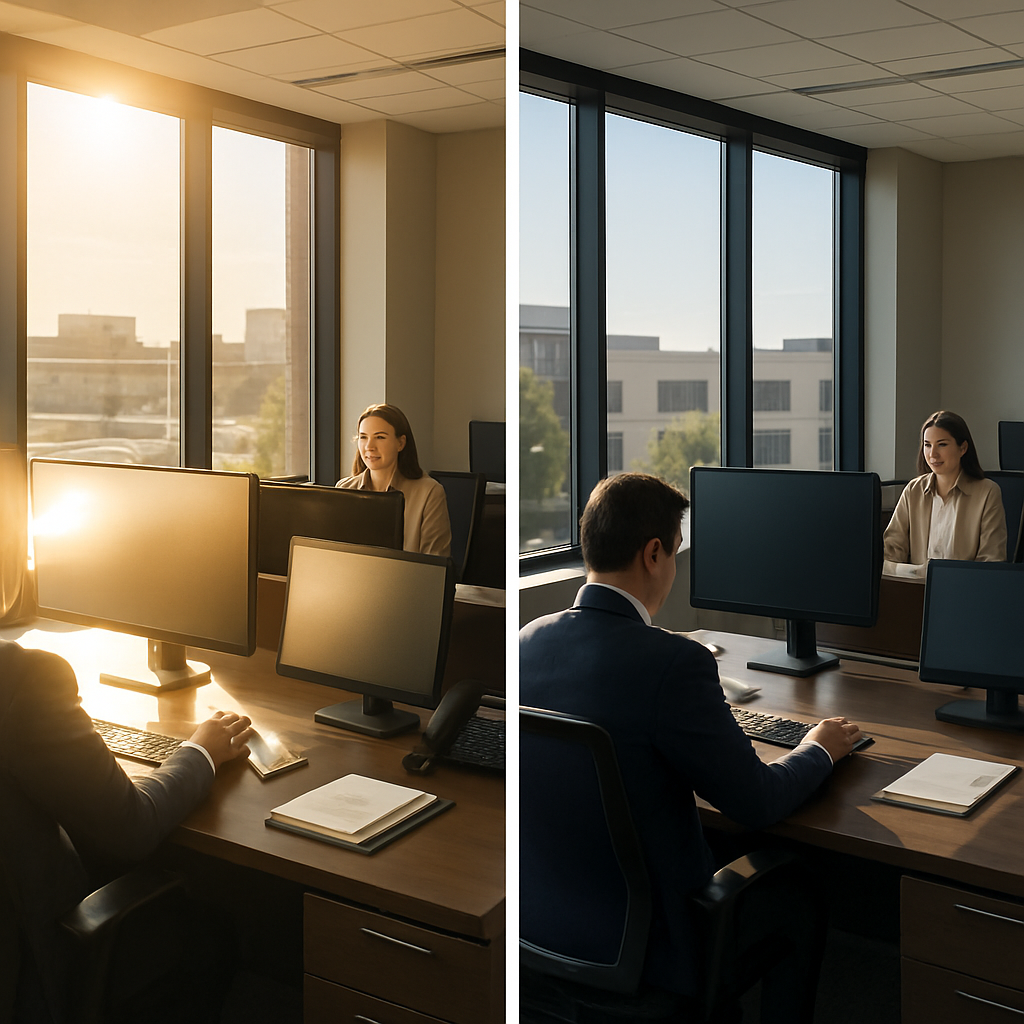
Takeaway: Start with a targeted pilot that measures both light levels and occupant response, then specify measurable VLT and SHGC targets in your procurement to avoid over-darkening or unwanted side effects.
Frequently Asked Questions
Straight answer up front: effective office window tinting hinges on what you are trying to change — glare, heat, privacy, or appearance — and where the glass faces. Pick a film to solve the specific problem for that facade, not the cheapest generalized option.
Short answers to common procurement and performance questions
How much glare reduction will I see: Modern spectrally selective and ceramic films typically deliver a noticeable drop in screen reflections without killing daylight. The degree of improvement depends on the film VLT you pick and the sun angle on the façade; west-facing workstations usually show the biggest perceptible change.
Will tinting darken the office or force more electric lighting: High-performance spectrally selective films are designed to keep VLT high while rejecting infrared. Expect minor changes to daylight appearance if you specify properly; the real risk is buying dyed or heavily reflective films because they do darken space and often prompt increased lighting use.
Does film stop UV fading: Yes — most commercial films block UV that damages fabrics and finishes. That protection is valuable for preserving interiors but it is not a substitute for addressing thermal comfort or glare through correct film specification.
Will film interfere with sensors or wireless equipment: Practical caution: metalized films can affect antennas, RFID, or IR sensors. If you have rooftop or perimeter equipment, insist on a site survey that maps sensitive devices and consider nonmetallic ceramic films if RF transparency matters.
How long will it last and what about warranties: Quality installations commonly last a decade or more; warranty terms vary by manufacturer and installer. Don’t accept vague claims — require specific warranty language on adhesion, peeling, and optical defects in your contract.
Historic or landmark buildings: Use high-clarity, low-reflectance films and get approvals early. Some commissions accept interior-applied, nonreflective films because they preserve exterior sightlines.
Common mistake to avoid: Choosing film solely on price or appearance. Cheaper dyed films frequently fail on performance and longevity. Spend the extra time on mockups and require measurable VLT/SHGC targets in proposals.
Concrete Example: A three-story nonprofit office in Salem had meetings disrupted by late-afternoon glare in a glassed conference room. They tested a low-reflectance frosted privacy film on one conference window and a spectrally selective film on the others. The frosted panel solved privacy without reducing daylight in adjacent spaces, while the selective film cut screen reflections and eliminated the need for blinds during meetings.
- Immediate actions: Run a small 5–10 window pilot with measurable before/after lux and occupant feedback; require bidders to meet VLT and SHGC targets.
- Procurement step: Ask for a sample mockup and demand written warranty and performance specs tied to manufacturer data sheets.
- Final check: Ensure the chosen film does not conflict with building systems or historic approvals and request rebate documentation if you plan to apply to Energy Trust of Oregon.
