
Tint Oregon: Comparing Residential and Commercial Window Films
If you are researching tint oregon options for a home or business in Portland, Salem, Eugene, or Bend, the choice between residential and commercial films matters more than most buyers expect. This post compares the two by the metrics that actually affect comfort and savings — VLT, SHGC, U-factor, and UV rejection — and gives real product examples, cost ranges, payback estimates, and Oregon-specific code considerations. You will walk away with clear recommendations for common local scenarios and a short checklist to vet installers and film choices.
Why this comparison matters in Oregon
Oregon's climate and building stock change what window film actually delivers. Summer heat spikes, strong late-afternoon sun on west facades, and long cloudy winters mean the value of a film depends on whether you prioritize daylight and view or solar control and code compliance.
Typical assemblies differ across cities. In Portland and Salem you still see many older single-pane and early double-pane windows; in Bend and newer builds you find double-pane low-e glazing and curtainwall systems on commercial properties. Those differences alter which film types are effective and safe: single-pane responds differently to low-e retrofit films than modern insulated units.
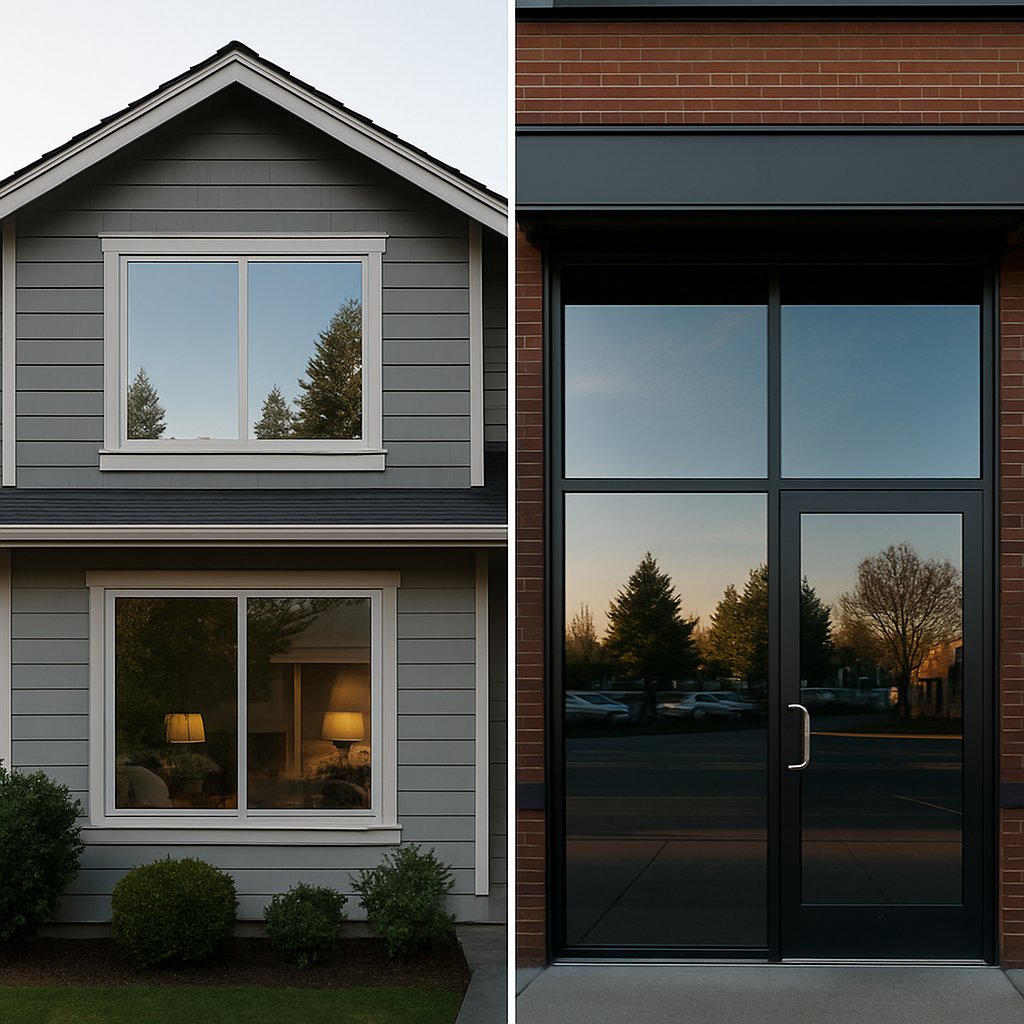
Residential goals are usually comfort, view retention, and UV protection; commercial goals add energy code alignment, tenant comfort, branding, and security. That means a homeowner in Eugene chooses a neutral ceramic film to keep daylight while cutting heat, whereas a property manager in Portland may need a reflective or low-e solution that produces measurable SHGC improvements and comes with compliance documentation.
There are trade-offs that matter in practice. High-reflectivity commercial films reject heat well but alter appearance, can impact window signage and storefront aesthetics, and sometimes trigger local historic-district restrictions. Ceramic films cost more upfront yet preserve color and view, which makes them the better fit for living rooms and bedrooms where occupant satisfaction drives value.
Concrete example: A west-facing living room in Portland with a large single-pane unit will get more day-to-day benefit from a high-VLT, low-SHGC ceramic film like 3M Prestige than from a dark metalized film. Conversely, a downtown retail storefront with heat and glare complaints plus security concerns will often need a commercial reflective film or a combination of reflective film with a security overlay to meet tenant and insurance requirements.
Regulatory and warranty consequences are real. Commercial retrofits frequently require data for the Oregon Energy Code and building inspectors. Use an installer who provides test data and warranty paperwork. Check Oregon Department of Energy and industry guidance such as the International Window Film Association when specifying performance targets.
Next consideration: Before you get quotes, define the glazing type and the one primary objective – comfort/view, energy compliance, or security – then match film families and installers accordingly. For local help, compare options with Tinting Oregon who work across Portland, Salem, Eugene, and Bend.
Key performance metrics and how to read them
Start with the numbers, not the marketing. When comparing residential and commercial window films in Oregon, the four objective metrics you must read on a datasheet are Visible Light Transmittance (VLT), Solar Heat Gain Coefficient (SHGC), U-factor, and UV rejection. These are the levers that determine daylight, glare, summer cooling, winter heat loss, and interior fading.
How to read each metric in practice
- VLT: Percent of visible light passing through. Higher VLT preserves view and daylight; lower VLT reduces glare and privacy. For homes you generally want a higher VLT to avoid darkening living spaces; for storefronts lower VLT can improve product display comfort.
- SHGC: Fraction of solar energy admitted. This is the single best indicator of cooling impact. A lower SHGC means less solar heat and smaller summer cooling load. Pick film for the facade and orientation you have, not a single lowest SHGC every time.
- U-factor: Measure of conductive heat transfer through the window assembly. Films rarely cut U-factor as much as replacing glazing, but low-e retrofit films can reduce winter heat loss meaningfully in Bend and other cold spots.
- UV rejection: Percent of ultraviolet blocked. Target 99% for protecting fabrics, wood floors, and artwork; this is cheap insurance and does not correlate directly with visible darkness.
| Metric | Practical meaning | Typical target range for residential Oregon | Typical target range for commercial Oregon |
|---|---|---|---|
| VLT | Daylight and view retention | 50 to 70% | 30 to 50% |
| SHGC | Cooling load reduction | 0.25 to 0.40 | 0.20 to 0.35 |
| U-factor | Winter heat loss; choose low-e when needed | Aim for measurable improvement; expect 5 10% reduction with low-e films | Specify NFRC-tested values; commercial façades may need documented U-factor |
| UV rejection | Fade protection | 99% target | 99% target |
Practical trade-off to watch: VLT and SHGC do not move together. A film can be visually light but cut heat well (ceramic, multi-layer films) or be very reflective and dark while blocking heat. In Oregon where daylight matters, prefer films that lower SHGC without dropping VLT excessively.
Concrete Example: A west-facing living room in Portland benefits from a ceramic film with VLT around 55 60% and SHGC near 0.30. Occupants keep natural daylight and view while solar gain and afternoon glare drop, which reduces AC cycling on heat wave days without making the room feel dim. For a retail storefront on the same street pick VLT 30 40% and SHGC 0.20 0.25 to protect merchandise and reduce interior cooling costs.
Read NFRC or manufacturer test conditions. Datasheet numbers are meaningful only when you know the glass assembly they were measured on; ask for NFRC-rated values or a test on a similar glazing type.
Common mistake and judgment: Many buyers fixate on percent heat rejection reported on marketing sheets instead of SHGC. Percent heat rejection can be misleading because it depends on incident conditions. Insist on SHGC and NFRC documentation for realistic comparisons, and be skeptical of comparative claims that lack standardized test data. For further reading on standards see International Window Film Association and ENERGY STAR guidance at ENERGY STAR.

Film categories, real product examples, and best use cases
Straight answer: pick the film category that matches the problem you need to solve, not the cheapest sticker. Solar control, security, decorative/privacy, and low-e retrofit films are distinct products with different performance metrics and installation requirements.
Residential solar control: high-performance ceramic and multi-layer films — for example 3M Prestige Series, Huper Optik Ceramic, or LLumar CTX — give strong heat rejection and ~99% UV block while keeping high visible light transmittance (VLT). They cost more, but the tradeoff is preserved daylight and minimal color shift; in practice that matters for living rooms and west-facing glass where view retention is a priority. Note: choose low-e compatible variants and professional installation to avoid thermal stress on insulated units.
Commercial solar/reflective films: products like Solar Gard Ultra Performance, LLumar High Performance, and metalized Vista films deliver bigger SHGC reduction per dollar and a reflective look that customers expect on storefronts and curtainwalls. The trade-offs are appearance (mirror-like finish) and possible interference with radio signals in some metalized films. Use these on storefronts, retail façades, and warehouse office partitions where uniform exterior appearance and glare control matter more than preserving expansive daytime views.
Security and safety films: 3M Impact Protection Film and Solar Gard Armorcoat are engineered for retention of glass fragments and forced-entry delay. They are sold by thickness and usually paired with mechanical anchoring for storefront frames. Real-world use case: after a smash-and-grab incident in a small Portland retailer, installing 8 mil security film plus perimeter anchoring reduced successful break-ins and lowered glazing replacement frequency — insurers often look for this documentation when adjusting premiums.
Decorative/privacy and low-e retrofit: films such as 3M Fasara, Avery Dennison decorative films, and Eastman SunTek low-e retrofit options solve different needs: conference-room privacy, branded frosts, or marginal winter thermal improvement on single-pane windows. Decorative films add no meaningful solar control; low-e films can help winter U-factor but must be chosen to avoid causing stress on sealed units.
| Category | Example product(s) | Best use case | Key trade-offs |
|---|---|---|---|
| Residential ceramic/multi-layer | 3M Prestige Series; Huper Optik Ceramic; LLumar CTX | West-facing living rooms, bedrooms where view matters | Higher cost; minimal color shift; low interference |
| Commercial reflective/metalized | Solar Gard Ultra Performance; LLumar High Performance; Vista Metals | Storefronts, curtainwalls, glare-prone offices | Reflective appearance; potential signal interference |
| Security/safety | 3M Impact Protection Film; Solar Gard Armorcoat | Ground-floor retail, schools, high-risk facades | Need anchoring; higher installation complexity; thicker films |
| Decorative / low-e retrofit | 3M Fasara; Avery Dennison; SunTek low-e | Conference rooms, bathrooms, historic windows, single-pane upgrades | Decorative films don't cut solar much; low-e must match glazing |
Practical judgment: in Oregon climate, I choose ceramic/multi-layer films for homes where daylight and view are priorities and commercial reflective films where façade uniformity and daytime glare dominate. Security films are non-negotiable for street-level retail; decorative films are for privacy and branding, not energy savings.
Concrete Example: A mid-century living room in Portland with large west-facing glass retained its bright feel after installing 3M Prestige Series (around 50–60% VLT) — afternoon heat dropped noticeably without the room going dark, and homeowner reported less fading on hardwood floors within six months.

Cost, energy savings, and payback in Oregon markets
Bottom line: Installed costs vary, savings depend on glazing condition and building use, and payback windows in Oregon fall into predictable bands: residential projects commonly 5 to 12 years and commercial projects commonly 3 to 7 years. For a reliable project estimate, get a site assessment from Tinting Oregon so the installer can measure glass area, note low-e coatings, and model local HVAC interactions.
What actually drives payback in Oregon
- Glass condition and baseline performance: Single pane or failing IGUs deliver the largest measurable savings; retrofitting high-performance double pane low-e glass yields much smaller energy returns.
- Orientation and solar exposure: West and southwest façades give the best summer savings in Portland and Eugene; in Central Oregon, high daytime solar plus cold nights changes the balance between cooling and heating tradeoffs.
- Building type and HVAC: Small homes with little AC will see more value in comfort and UV protection than in dollarized energy savings; commercial spaces with central HVAC and high cooling loads show faster payback.
- Film choice and installed cost: Ceramic and neutral films cost more but keep VLT high and view intact; reflective or metalized films can reject more heat for less cost but may be unacceptable for residential aesthetic goals.
Practical tradeoff: In much of Oregon, the most common mistake is treating solar control film as an energy retrofit only. For many homeowners the primary returns are reduced glare, preserved furnishings, and fewer AC runtime hours during heat events. For commercial owners the direct HVAC savings plus tenant comfort and reduced peak demand are the core economic drivers.
| Project | Glass area | Installed cost | Assumptions | Estimated annual energy savings | Estimated payback |
|---|---|---|---|---|---|
| Residential west-facing living room | 200 sq ft | $1,200 to $2,400 | Ceramic solar film, existing double pane, moderate AC use | $100 to $300 | 5 to 12 years |
| Retail storefront with heavy solar load | 1,000 sq ft | $8,000 to $15,000 | Reflective solar film, central HVAC, daytime occupancy | $1,500 to $5,000 | 3 to 6 years |
| Open-plan office retrofit | 2,000 sq ft | $16,000 to $40,000 | Mixed exposure, tenant comfort and glare control prioritized | $3,000 to $8,000 | 3 to 7 years |
Concrete example: A downtown Portland bookstore replaced clear storefront glass with a neutral ceramic film across 900 sq ft. Installed cost was about $10,500. The owner reported lower peak cooling demand, fewer overheated afternoons, and measured HVAC energy reductions that produced an estimated payback of roughly four years after factoring in improved customer comfort and reduced UV damage to inventory.
What does not pay back on energy alone: Security and heavy duty impact films are often the right choice for risk mitigation but they rarely recover their full cost through energy savings. Treat those products as safety investments rather than energy measures.
Next consideration: If payback is a primary decision point, prioritize projects with high solar exposure or poor baseline glazing, request modeled savings from the installer, and schedule an on site audit with Tinting Oregon so the estimate reflects local climate, glass type, and warranty obligations.

Installation, warranties, and long-term maintenance
Installation quality controls the outcome more than the product label. A good film installed poorly will fail early; a mid-tier film installed correctly will often outlast a cheap film slapped on by an untrained installer. For commercial projects the difference is literal: warranty acceptance, building inspections, and tenant disruption all hinge on professional installation and documented procedures.
What professional installation must deliver
Key installation practices: edge sealing, correct wetting solutions, heat shrinking on certain films, and careful handling of tempered or low-e glass. Edge sealing matters. Many failures we see—peeling, staining at the perimeter, early delamination—trace back to poor or missing edge seal, especially on ground-floor storefronts and in coastal or high-humidity areas.
- Pre-install inspection: confirm glass type (annealed vs tempered vs low-e), frame condition, and any prior coatings.
- Mock layout and VLT sample: place a sample patch so stakeholders can confirm daylight and appearance before full install.
- Edge treatment: for commercial and high-exposure windows insist on full perimeter sealing and proper drainage paths.
- Post-install documentation: photographs, film batch numbers, and care instructions for facility managers.
Practical trade-off: mobile installers and same-day jobs reduce downtime but raise risk. Mobile shops are fine for small residential patches; for multi-floor commercial work schedule shop-based prep or staged installs to preserve quality control and warranty paperwork.
Warranties — what they actually cover
Manufacturer vs installer warranty. Manufacturers such as 3M, LLumar, Huper Optik, and Solar Gard provide material warranties for discoloration, adhesive failure, and peeling, but most require professional installation to remain valid. Installer workmanship warranties cover fitting errors, bubbling from poor installation, and edge sealing failures—get both in writing.
- Duration differences: some residential films carry 10–20 year limited warranties; high-end commercial/security films may have 7–15 year terms with different coverage clauses.
- Labor coverage: manufacturer warranties often exclude labor after an initial period—confirm who pays for rework.
- Conditions that void warranties: using abrasive cleaners, modifying the glass (drilling, adding tints afterward), or improperly sealed units.
Concrete Example: A small retail storefront in Portland replaced aging reflective film. The original install had no perimeter seal; after two wet winters the film began lifting at the edges. The manufacturer denied a full refund because the original installer had not applied recommended edge seal. The corrective path was a professional re-install with full edge sealing and a clear installer workmanship warranty to avoid the same repeat failure.
Maintenance that preserves performance and warranty
Routine care is simple but non-negotiable. Use a mild soap and water solution, a soft microfiber cloth or squeegee, and avoid ammonia or abrasive pads. For commercial properties create a maintenance schedule and train janitorial staff on approved products—many warranty claims are disallowed because cleaners or adhesives were used near edges.
- Month 1: visual check for edge lift and trapped moisture; photograph for records.
- Quarterly: clean with pH-neutral cleaner and inspect seals, especially on north-facing and shaded facades.
- Annually: have a pro inspection to check adhesion, edge condition, and film optical stability; retain inspection reports for warranty claims.
Final judgment: for anything beyond a single-pane residential bedroom or auto tint Oregon job, professional installation is worth the premium. It preserves performance, keeps warranties intact, and prevents the most common real-world failure modes—edge lift, adhesive breakdown, and thermal stress damage on low-e glass.
Codes, permitting, and durability considerations for commercial projects
Key point: commercial window film projects are treated differently than residential jobs—inspectors and building owners expect documentation, compatibility statements, and evidence that the film won't create safety, egress, or fire-performance problems. This is not paperwork for its own sake; it affects approvals, insurance, and whether the film can stay on the job long-term.
What building officials and facility managers will actually require
Typical requests: plan submittal with manufacturer product data (VLT, SHGC, UV rejection), a statement of compatibility for low-e or tempered glass, and warranty documentation. Many jurisdictions accept these digitally, but for remodels that change thermal or solar properties you may have to show code compliance with the Oregon Energy Code—bring numbers, not marketing copy. See the Oregon Department of Energy guidance on efficiency measures for reference: Oregon Department of Energy.
Practical limitation: some films alter the thermal stresses on tempered or heat-treated glass and can increase the risk of spontaneous breakage in commercial storefronts. A qualified installer should evaluate glass type and either select low-stress-compatible films or recommend glass replacement. Expect owners or insurers to insist on a manufacturer compatibility letter for projects on heat-treated glazing.
Durability issues that matter on larger buildings
Durability trade-off: high-reflective and metalized films reject more heat but age differently than ceramic films—metal films can show corrosion at cut edges or under aggressive cleaning regimes. For façades subject to direct sun, weather, or street-level abrasion, choose films with explicit commercial exposure ratings and longer commercial warranties.
- Documents to collect: manufacturer data sheet, low-e/tempered compatibility statement, warranty certificate, and lab test reports for SHGC/VLT/UV.
- Installer deliverables: site photos, material batch numbers, edge-sealing method, and a maintenance schedule for on-site staff.
- Risk items to flag: historic-district restrictions, potential glare to adjacent traffic, and fire-rated glazing where film is often prohibited.
Concrete example: a retail owner in downtown Portland wanted reflective film on a historic storefront. The city planning office required a design review because of the district, and the building inspector wanted a low-e compatibility letter before issuing a no-permit-needed memo. The project went forward only after the installer provided manufacturer lab reports and a one-window mockup so the reviewer could confirm appearance and glare impact.
Judgment call: for mid- to large-scale commercial retrofits, treat permitting and test data as an essential line item in the budget and schedule. Cutting corners on paperwork or skipping a compatibility check often causes costly rework or insurance headaches later. Hire an installer who regularly submits submittals to building departments and can provide the test reports you will be asked for.
Decision framework and scenario recommendations
Start with a ranked objective list. Name the primary outcomes you need – for example comfort, energy savings, security, historic appearance – and rank them. That ranking drives everything from film family to allowable visible light loss, and it prevents scope creep during procurement.
Five-step decision framework
- Clarify the dominant problem. Is it peak-summer glare, tenant complaints, theft risk at street level, or winter heat loss? Write a one-line problem statement for each elevation or tenant space.
- Inspect and record glazing condition. Note glass type, edge condition, spacer failure, and manufacturer stickers. If more than 20 to 30 percent of units show seal failure, replacement may be a better value than film retrofit.
- Require objective performance data. Ask bidders for NFRC or manufacturer test sheets, not marketing copy. Specify deliverables in the RFP: sample panels, measured VLT and SHGC, and warranty assignment terms.
- Pilot before full rollout. For commercial or aesthetic-sensitive installs, require a single-bay mockup. Measure occupant responses and interior temperature changes for two weeks during representative weather.
- Phase and verify. Install in waves, monitor HVAC runtime, and collect occupant feedback. Use hard acceptance criteria tied to the RFP metrics before approving subsequent phases.
Practical tradeoff to acknowledge. Piloting costs time and some extra expense, but skipping a mockup is the most common reason projects fail to meet expectations. A single failed bay can mean complaints, rework, and warranty disputes that cost far more than the pilot.
| Scenario | Recommended film approach | Procurement note |
|---|---|---|
| West-facing living room in Portland | Neutral ceramic/multi-layer solar control to keep daylight while reducing peak heat | Require a mockup and VLT target that preserves occupant daylight |
| Street-level retail storefront in Salem | Security film for lower panes plus selective reflective film above to reduce glare | Ask for impact test data and insurance endorsement language |
| Open-plan office with glazing in Eugene | Combination of low-reflectivity solar film and decorative privacy film for meeting rooms | Specify sample swatches for color and ensure no signal interference for IT |
| Historic home in Bend | Low-appearance, high-UV block film or decorative privacy film that preserves sightlines | Check local historic district approvals first and include reversible-install clause |
Concrete example: A multi-tenant owner in downtown Salem had repeated smash and grab events at one storefront. The recommended approach was a two-stage retrofit – install Solar Gard Armorcoat security film on the lower 6 feet of the storefront and a neutral solar control film above. The owner required a single-bay pilot and 3M or Solar Gard test data in the contract; after the pilot reduced break-ins and tenant complaints, the owner rolled the work out to three adjacent bays.
Judgment call most owners get wrong. People treat film as a low-cost cosmetic fix and skip performance specs. In practice the installer and the spec determine performance more than brand name alone. Insist on measurable acceptance criteria, a pilot, and written warranty transfer terms.
Next consideration. When you are ready to get quotes, include the pilot requirement, demand technical sheets, and ask for references for similar Oregon projects. If you want a template RFP language or a short checklist to give bidders, Tinting Oregon can provide one based on local code and climate experience; also consult International Window Film Association for standard test references.
