
Commercial Storefront Safety Film: Prevent Break-Ins and Reduce Vandalism Damage
If storefront glass keeps costing you time and money in Portland, Salem, Eugene, or Bend, commercial storefront safety film is a practical retrofit that slows smash-and-grab attacks, contains shards, and reduces repair bills. This guide cuts through marketing claims to show which film thicknesses, attachment methods, testing standards, and installer credentials drive real-world protection, cost, and ROI so you can pick the right solution for your property.
Why storefront glass is a high-risk target in Oregon commercial districts
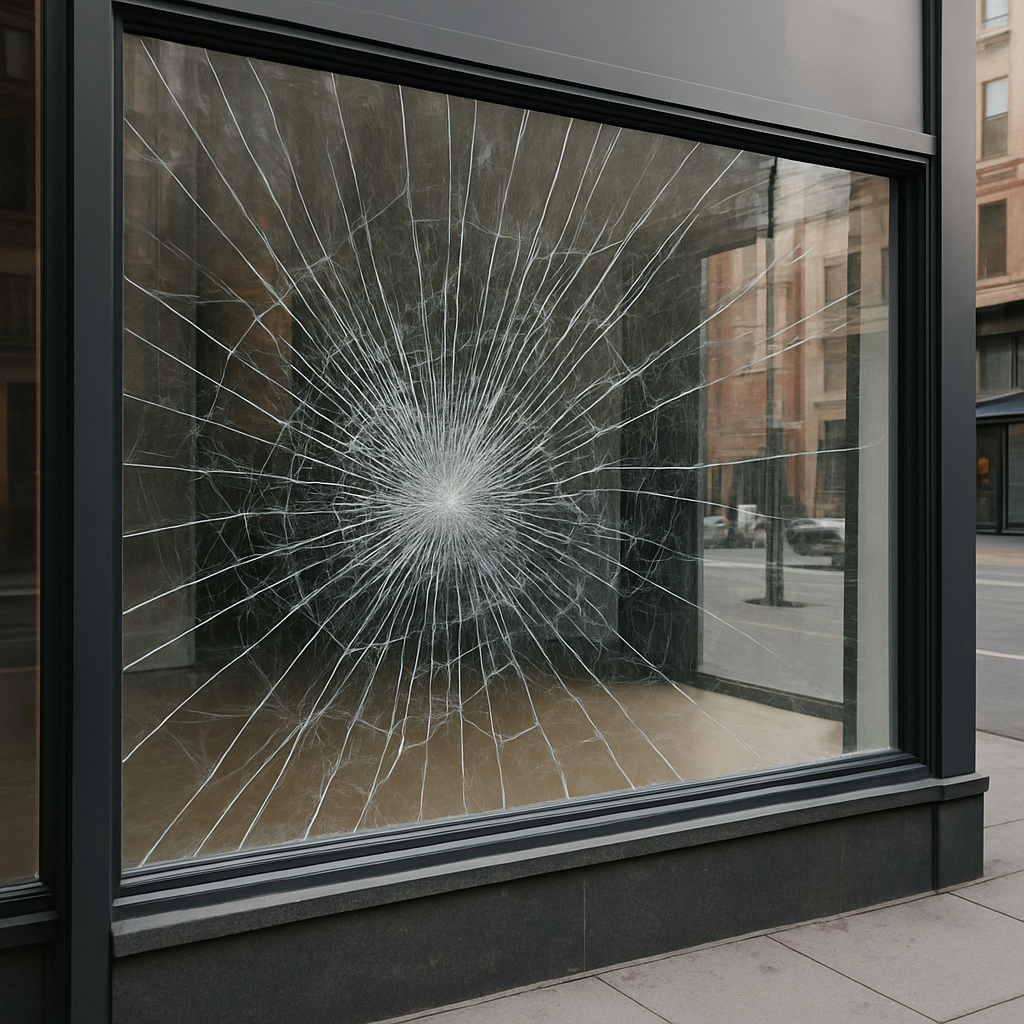
High exposure in plain sight. Storefront glass faces the street, carries merchandise value in clear view, and is often the weakest element of a building envelope. In Portland, Salem, Eugene, and Bend many downtown and neighborhood retail façades still use single-pane annealed glass or standard tempered panels that are easy to strike, shatter, and exploit during short-window smash-and-grab incidents.
Common vulnerabilities that make glass a target
- Annealed single-pane glass: breaks into large, sharp shards and offers almost no delay to an intruder
- Tempered glass: fragments into smaller pieces but still allows fast penetration if not laminated or retained
- Large uninterrupted panes: big vision areas remove physical obstacles and give thieves clear access to displays
- Poor perimeter retention: film glued only to the surface without mechanical anchoring can still allow removal of whole sections
- High-foot-traffic corridors and transit stops: concentration of potential perpetrators and quick escape routes increase incidents
Costs go beyond the broken pane. Direct expenses include emergency glazing, inventory loss, and lost sales during repairs. Indirect costs are often larger and overlooked – higher insurance premiums, potential legal liability from shard injuries under OSHA guidance, and damage to customer confidence that can depress foot traffic for weeks. National trends in property crime and local reports from the Portland Police Bureau show these incidents cluster in certain commercial corridors, so location matters when weighing upgrades. See IWFA security and safety resources for evidence on how glazing upgrades change outcomes.
Practical insight and limitation. Installing commercial storefront safety film frequently reduces the scale of damage and the chance of a successful smash-and-grab, but it does not make glass impervious. Performance depends on film thickness, adhesive quality, and critically on how the film is retained at the edges. For predictable results request products tested to standards such as ASTM F1642 and insist on installation methods that include edge retention or mechanical anchoring when the goal is delay and deterrence.
Concrete example: A mid-size retail tenant on a busy Portland corridor with large single-pane windows chose a clear 8 mil safety film plus perimeter anchoring rather than immediate full-glass replacement. After an attempted smash the film held the shards, prevented a quick entry, and limited damage to the storefront so the store reopened within 24 hours with a temporary board while a single pane was scheduled for replacement. The business avoided a full night of lost sales and substantially reduced emergency glazing costs.
- Tradeoff: film is lower cost and faster to install than laminated replacement, but thick film with anchors is required for serious delay – thin film without anchoring mainly reduces shard ejection
- Location judgment: properties near transit hubs or in high-crime corridors should prioritize thicker films and mechanical retention; quieter suburban strips can often start with clear safety films
How safety and security film works and what it actually protects against
Straight answer: commercial storefront safety film does two distinct jobs — containment and delay — and those two effects are what reduce injuries, slow smash-and-grab attempts, and cut clean-up and replacement costs.
What the film is and the basic mechanisms
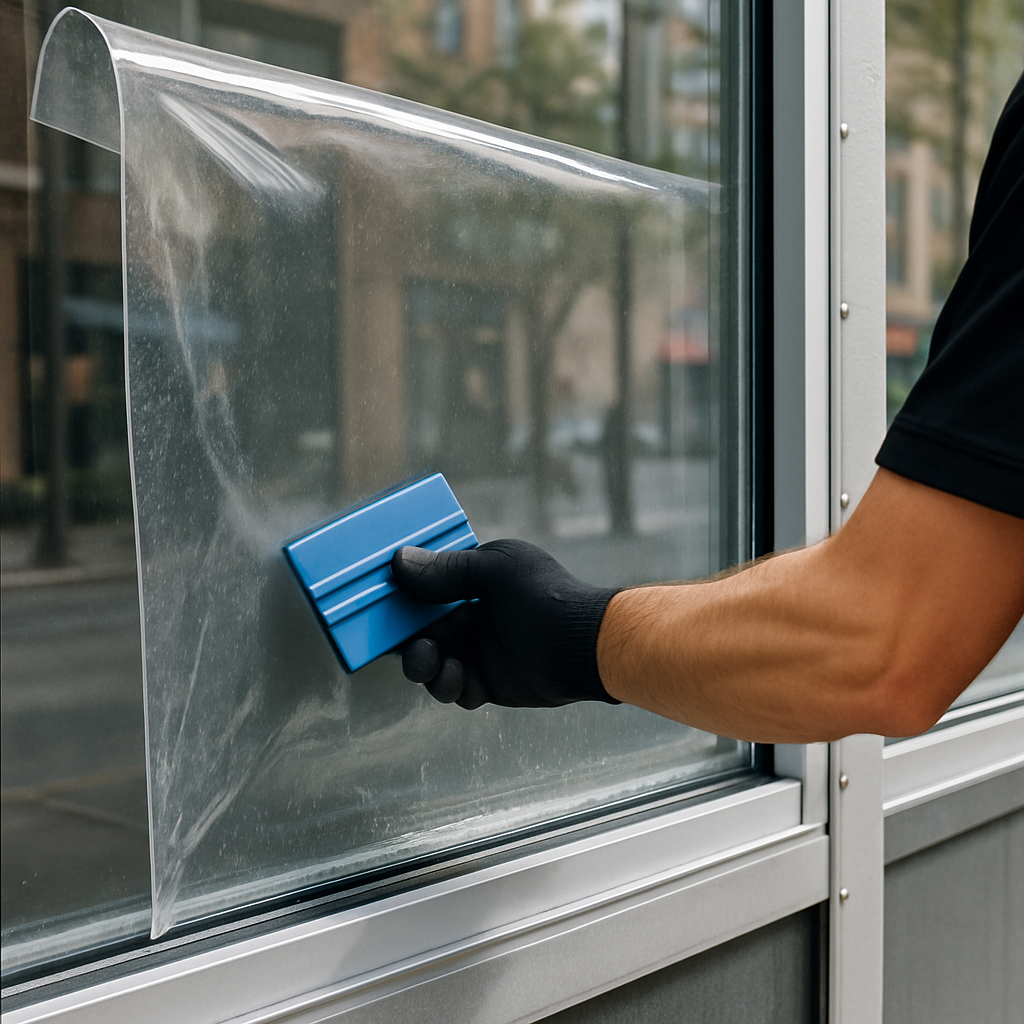
Construction: Most security and safety films are multi-layer polyester sheets with pressure-sensitive adhesive and a protective release liner; high-performance products add multiple polymer layers, ceramic or metal coatings for solar control, and proprietary adhesives for long-term bonding. The film bonds to the glass surface and holds fragments together when the glass is struck.
- Containment: The primary safety benefit is shard retention — film keeps broken glass attached to the film layer so shards don't spray into the store and injure people.
- Delay: Thicker films and systems with edge retention or mechanical anchors increase the time and effort required to make an opening large enough to enter.
- Deterrence: A film-treated window looks the same from a distance, but the added effort and noise required to breach it makes opportunistic criminals move on to easier targets.
Performance depends on two things: film thickness (mil rating) and how the film is attached at the edges. A 4–7 mil safety film primarily reduces flying shards; an 8–20 mil security film increases delay to entry — and paired with perimeter anchors or channel systems it becomes significantly more effective. For test context, see ASTM F1642 and EN 356 for how impact resistance is measured (ASTM F1642, IWFA security overview).
Limitations you must accept: Film does not make glass unbreakable. A determined attacker with heavy tools or enough time can still gain entry. Film is not a substitute for locked doors, alarms, good lighting, or active deterrents. Expect improved outcomes, not invulnerability.
A realistic use case
Concrete example: A downtown boutique applied a 12 mil commercial security window film and mechanical edge channels on three street-facing panes. During an attempted smash-and-grab, the store recorded that the window failed to open cleanly and the attempt took several minutes; the thieves abandoned the effort when an alarm was triggered. The store avoided full-pane replacement, staff injuries were prevented, and downtime was limited to a single business day while the film and retained glass were inspected.
Practical trade-off: Thicker, mechanically anchored systems cost more and take longer to install, but they deliver outsized reductions in time-to-entry and cleanup costs. If budget is tight, choose clear 7–8 mil film with professional edge finishing as a minimum — it preserves displays and reduces shard risk — then plan upgrades to anchored systems where risk justifies the spend.
Judgment you won't get from marketing copy: Opt for a tested system. Vendors love quoting mils; installers who document edge retention and provide lab reports deliver predictable performance in the field. If your storefront is in a higher-risk commercial corridor in Portland, Salem, Eugene, or Bend, budget for anchored security film up front — it pays for itself by reducing repeat replacement and liability exposure.
Performance standards, tests, and certification to evaluate
Demand evidence, not marketing copy. When evaluating commercial storefront safety film, the deciding factor is whether the product and the installed assembly were tested under conditions that mirror your storefront — that means the same glass type, frame condition, and whether the film was mechanically anchored or simply surface-applied.
Standards that actually matter and what they measure
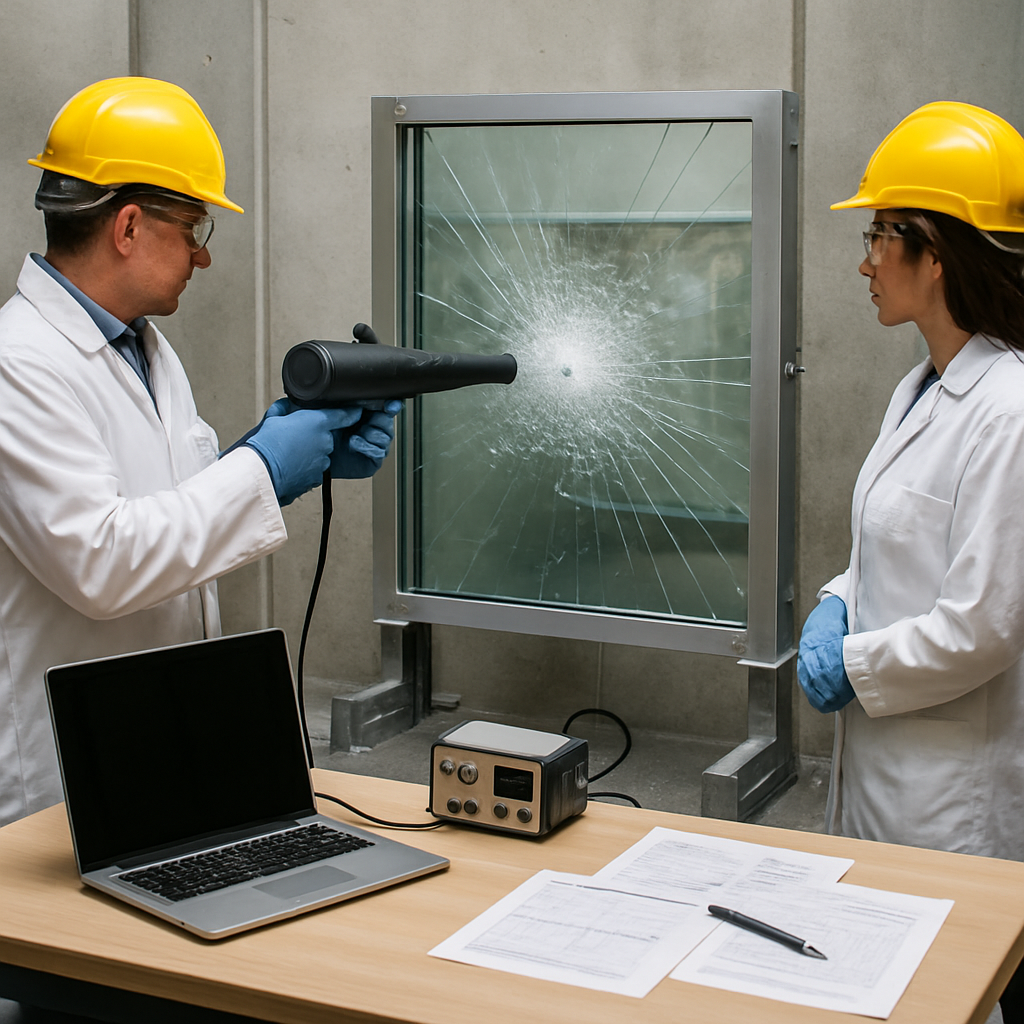
The three standards you will see most often are ASTM F1642, EN 356, and UL 972. Each answers a different question: can the treated glazing resist projectile impact, manual attack, or meet burglary-resistance criteria? Read the test protocol, not just the standard name — the number of impacts, projectile mass, energy, and whether edge retention was used change everything. See the International Window Film Association resources for background: IWFA security and safety.
| Test / Standard | What it measures | Why it matters to you |
|---|---|---|
| ASTM F1642 | Projectile impact tests using steel or concrete projectiles at specified energies | Shows how well a film assembly resists flying objects and simulated ram attacks; look for the exact test energy and number of shots |
| EN 356 | Classification P1A–P8B for resistance to manual attack using hammers, axes, and hand tools | Gives a graded resistance scale for hand-tool attacks; P levels help compare products on a common axis |
| UL 972 / Burglary-resisting glazing | Evaluation against forced entry scenarios and certain attack methods | Useful when insurers or local codes reference UL listings; confirm the listed configuration matches your installation |
Thickness is a proxy, not a guarantee. Film mil ratings (4, 7, 8, 12, 20 mil) correlate with delay-to-entry, but a 12 mil film installed without perimeter anchoring will still fail faster than a 7–8 mil film properly anchored in a channel system. Thicker films increase cost and handling difficulty, and they can slightly change visual clarity — a trade-off you need to accept consciously.
- What to request with any quote: product data sheet, independent lab test reports showing test setup, confirmation whether tests included edge retention, installer certification from the manufacturer, and the exact glass type used in testing.
- Verify test conditions: was the film tested on annealed or tempered glass, single pane or insulated glazing, and did the test use a mechanical anchoring system?
- Watch for overstated claims: vendor literature sometimes lists a standard without the full protocol; ask for the test report page that lists projectile mass, energy, number of cycles, and pass/fail criteria.
Concrete Example: A downtown Portland boutique had a pattern of rock-throw vandalism. They installed a mid-thickness security film paired with a perimeter channel. During a later attack, multiple panes fractured but the film and channel held the glass fragments in place; the store stayed closed only a single day for a board-up and cleaned film inspection rather than full glass replacement and two weeks of downtime.
In practice, independent lab numbers are useful only when you can match the test assembly to your storefront. My judgment: prioritize test reports that include anchored assembly results, not just surface-film shots. Anchored assemblies are the difference between a deterrent that buys minutes and a lab result that buys marketing copy.
If a test report does not explicitly state that edge retention or mechanical anchoring was used, treat the performance claims as optimistic.
Next consideration: when you gather quotes, compare the test reports side-by-side and check that the tested assembly matches your glass, frame, and whether you plan to use a perimeter channel; if not, ask the installer to quote the anchored system that was actually tested. For local installations and on-site assessments, see our storefront installation guidance: Storefront Window Film Installation.
Film types and product lines to consider for storefront protection
Not all commercial storefront safety film is built the same. Choose by the threat you face, the look you need to preserve, and whether you plan to add mechanical edge retention. Product families differ on thickness options, adhesive chemistry, and whether they are designed to work with anchoring systems — and those differences matter more than brand logo.
Commercial product families you'll see and what they do
- Clear safety films (4–7 mil) – Primarily shard containment. Useful where occupant safety and minor vandalism resistance matter but not intended to significantly delay a forced entry.
- Security/anti-shatter films (8–20+ mil) – Thicker polyester builds that increase time-to-entry. These are the workhorses for retail storefronts when combined with proper edge retention.
- Reinforced/anchorable systems – Film plus perimeter channel, mechanical anchors, or heavy-duty tape. These systems change the failure mode of the assembly and are the only retrofit that approaches laminated glazing performance for delay-to-entry.
- Decorative safety films – Provide privacy or branding while adding a safety layer. Good for storefronts that need display control but still require shard containment.
- Energy-efficient safety films – Combine solar control and UV protection with safety properties. They cut glare and heat while offering safety benefits; useful where comfort and theft-reduction are both objectives.
- Specialty high-performance films (blast/ballistic rated) – For extreme risk profiles. These are expensive and rarely justified for small retail locations; they belong to buildings with documented higher-threat exposure.
Practical insight: if your primary goal is to prevent smash-and-grab theft, start by evaluating 8–12 mil security films plus a perimeter anchoring option. Films thinner than 7 mil reduce injuries from glass but offer limited delay. Films above 12 mil give more delay but increase material and install complexity.
Trade-off to plan for: clear films preserve displays and curb appeal but provide no visual deterrent. Mirrored or heavily tinted security films deter voyeuristic thefts but can reduce foot traffic to window displays. Balance security benefit with brand and leasing needs.
Concrete example: A downtown Portland boutique installed a 12 mil clear security film with a mechanical channel at the top and heavy adhesive tape on the jambs. After a smash attempt, staff reported the thieves abandoned the entry after repeated strikes; repairs were limited to the film and tape rather than full glass replacement, cutting downtime and repair cost materially.
Manufacturers you should research include recognized commercial lines such as 3M Scotchshield, Llumar Safety and Security Films (Eastman), and Madico Armorcoat. Inspect product data sheets and independent test reports — don't accept marketing claims alone. Use IWFA resources and manufacturer pages like 3M to compare certified test data.
Hard fact: thicker film alone helps, but the installation method determines whether that thickness actually delays entry in a real attack.
Next consideration: match the product family to installation approach and real-world constraints on your building. If you need help picking the SKU and attachment system that balances cost, appearance, and measurable security for Portland or Central Oregon conditions, request on-site samples and a documented test-method statement with any quote — that one step separates effective projects from cosmetic upgrades.
Installation methods and why edge retention or mechanical anchoring matters
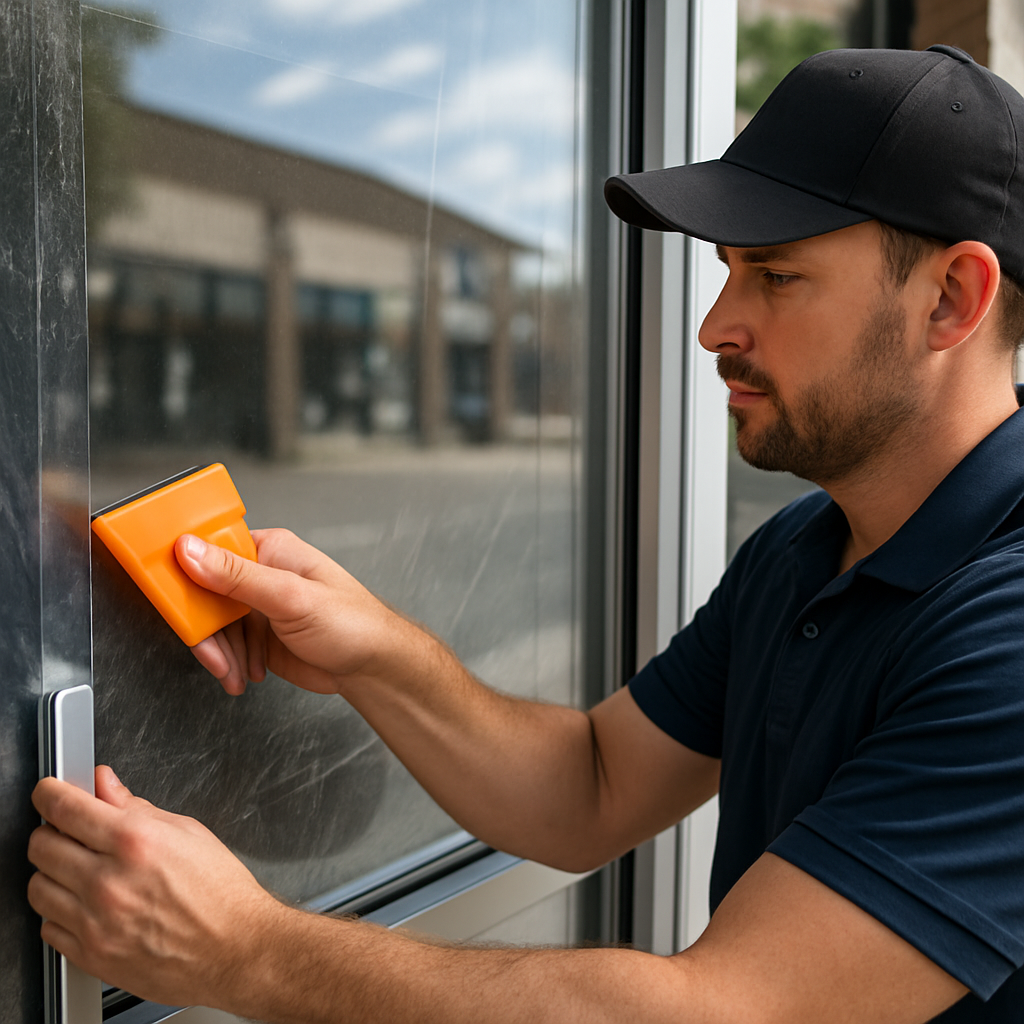
Edge retention turns film from a cosmetic add-on into a delay system. Applied only to the glass surface, even heavy security film will still allow glass to fall out of the frame under focused attack. Anchor the film to the frame or create a retained glazing assembly and you change the failure mode: the attacker must cut through film and defeat the anchors as well.
Common attachment approaches and how they compare
- Surface-only with sealed edge: Film adhered to glass with edge sealant or tape. Lowest cost and preserves sightlines, but provides only fragment retention — limited delay to entry.
- Perimeter channel (U-channel) retrofit: A metal channel is installed over the film edge and fastened to the frame. Good balance of performance and appearance for aluminum storefronts; significantly increases time-to-entry.
- Mechanical anchors with plates: Stainless-steel anchors or plates bolted through the frame or clamped to mullions. Highest delay performance for retrofit work, but more invasive and costlier.
- Wet-glaze structural adhesive: Film is bonded plus a structural bead applied to bite the glass into a restored or reinforced frame. Works well when frames are being refurbished or replaced.
Practical insight: manufacturers often publish test numbers based on film applied to glass without anchors. Those numbers are useful, but they understate real-world performance when an attacker can pry the glass out of its frame. Conversely, quoted results that claim high resistance without specifying the anchoring method should be treated skeptically — ask how the specimen was retained during testing (see ASTM F1642 for impact test context at ASTM F1642).
Trade-off to accept: mechanical anchoring raises cost and can alter the storefront aesthetic or complicate storefront weatherproofing. It also may require coordination with landlords, millwork trades, or permit reviews. But if your priority is reducing smash-and-grab success and keeping staff safe, the additional cost is more often justified than cosmetic concerns.
What to verify on-site — anchoring-specific checks
- Frame compatibility: Confirm the existing frame has sufficient bite and structural condition to accept a channel or anchors; corroded frames often need repair before anchors work.
- Anchor embedment and fastener specs: Request the fastener type, embedment depth, and torque specs — these determine actual holding capacity.
- Edge finish and sealant: Ask whether the edge will be exposed, sealed with silicone, or covered by a metal channel; exposed tape often fails sooner under UV and moisture.
- Photographic documentation and method statement: Installer should provide before/after photos and a written description of the anchoring method tied to the film's test data.
Concrete example: A downtown Portland boutique installed 8‑mil commercial storefront safety film plus a perimeter metal channel. When vandals smashed several panes one night, the film-channel assembly prevented the glass from ejecting and slowed entry long enough for staff to activate an interior lock and call security. The store avoided a full-frame replacement and reopening time was measured in hours instead of days.
Judgment you need to make: if you expect opportunistic smash-and-grab attempts, invest in anchored systems. If the goal is only shard containment for occupant safety inside the building, surface-only film may be acceptable. Many buyers misunderstand these two distinct outcomes and choose the cheaper surface-only option without weighing the security trade-off.
Ask for the film test report plus a description of how the specimen was edge-retained during testing — if the vendor cannot or will not supply that, assume the quoted performance excludes anchoring benefits.
If you want a next step, ask your installer for a written anchoring plan linked to the film's test data and a price option for surface-only versus anchored installation. For local examples and method descriptions, see our storefront installation overview at Storefront Window Film Installation.
Cost, expected ROI, insurance implications, and maintenance
Quick reality check: commercial storefront safety film installations in Oregon commonly range from about 8 to 25 USD per square foot, with wide variation driven by film thickness, anchoring method, and logistics. Cost is predictable; value depends on the specific risks at your location and which installation method you choose.
How to read the price and what changes it
Cost components matter more than headline price. The quoted per square foot number typically bundles material, labor, surface prep, masking, and cleanup. Expect incremental charges for perimeter anchoring systems, scaffolding or lifts, removal of existing film, and nonstandard glass shapes. Thicker films and manufacturer-certified anchors add up front cost but change the risk profile materially.
- Material thickness and brand: 4 to 7 mil films sit at the low end; 8 to 12 mil are common for retail; 20 mil and above are specialized. Brands with independent testing carry premium pricing.
- Attachment system: Surface-mounted film increases fragmentation resistance. Mechanical anchors or channel retention add 50 to 200 percent over film-only pricing but significantly increase delay-to-entry.
- Site logistics: After-hours installation, street permits, and scaffold time increase labor cost especially in dense downtown locations like Portland.
- Glass condition and configuration: Curved glass, transoms, or doors require extra labor and costing.
Realistic ROI and how to calculate it
ROI is incident-driven. For high-risk stores a single prevented smash-and-grab can pay for the upgrade. For low-incidence locations ROI will rely on reduced replacement frequency, lower downtime, and potential insurance credits.
Concrete example: A boutique with 200 square feet of storefront glass chooses a 12 mil commercial security film with perimeter anchors at 15 USD per square foot. Installed cost = 200 x 15 = 3,000 USD. A single break-in that shatters the panes could cost 6,000 to 10,000 USD to replace glass, plus 1,500 to 3,000 USD in lost sales and emergency repairs. If the film prevents or limits one such event the upgrade pays for itself in that single incident.
Do not treat that example as a promise. Estimate ROI by listing realistic costs you face from a break-in: glass replacement, inventory loss, board-up and emergency glazing, lost days of operation, and increased staff time. Multiply those by local incident probability to get an expected annual loss and compare to the film amortized over its warranted life.
| Protection approach | Typical installed cost (USD/sq ft) | Practical benefit |
|---|---|---|
| Film only (clear, 7 to 12 mil) | 8 – 15 | Reduces shard ejection and delays entry slightly; low disruption to install |
| Film with mechanical anchoring | 15 – 25+ | Significant delay to entry; best retrofit option short of replacing glazing |
| Laminated or replacement impact glazing | 50 – 120+ | Highest performance and permanence; long downtime and larger upfront cost |
Insurance, warranties, and maintenance realities
Insurance will not automatically credit you. Some carriers offer premium reductions or lower deductibles for documented security upgrades, but they require product test data, proof of professional installation, and sometimes an inspection. Present independent test reports such as ASTM F1642 summaries and installer certification when you request a credit. See the International Window Film Association for background on accepted testing: IWFA resources.
Maintenance is low but not zero. Clean with manufacturer-recommended mild cleaners and soft cloths, inspect after any impact, and avoid abrasive tools. Warranties for optical clarity and adhesive can range from 5 to 15 years; security performance claims may be limited if film is not maintained or if anchoring is modified. Keep the product data sheet and installation report accessible for both warranty and insurance documentation.
Practical tradeoff to accept: If your priority is shortest downtime and lowest initial cost, film-only installs win. If your site sees repeated attacks or you need documented delay-to-entry, budget for anchors or consider replacement laminated glazing despite higher cost.
Next consideration: schedule a site assessment and ask your insurer for pre-installation requirements so quotes include the documentation you need to realize any potential premium benefits. For local guidance on combining energy rebates with security installations, see Window Film Energy Rebates in Oregon and for typical storefront installation scope review Storefront Window Film Installation.
Choosing a contractor in Portland, Salem, Eugene, and Bend: what to ask and documents to request
Start local and expect proof. For commercial storefront safety film, the installer matters as much as the product. Insist on contractors who can show local, commercial projects in Portland, Salem, Eugene, or Bend, explain attachment options, and provide manufacturer-backed certifications — not just homeowner tinting experience.
Questions to ask during the site visit
- Experience: How many commercial storefront security film installs have you completed in my city or similar downtown/mall environments? Ask for local references and photos.
- Manufacturer certification: Are you certified by the film manufacturer (for example 3M or Llumar)? Request the installer certificate and the scope of that certification.
- Attachment methods: Do you recommend surface-only film, channel/retainer systems, or mechanical anchoring for my storefront? Ask them to explain the tradeoffs in writing.
- Testing and mock-up: Can you provide an on-site adhesion test or install a small mock-up pane so I can see optical clarity and edge finishing before full rollout?
- Warranties and repairs: What does the film warranty cover versus your labor warranty? Who handles warranty claims and what are transfer rules if I sell the property?
- Insurance and safety: Can you provide proof of general liability and worker's comp insurance and confirm installers follow OSHA safety practices for storefront work?
- Timeline and disruption: How many days will the job take, what are work hours, and how will you protect displays and perform cleanup?
Documents you must get with any quote
| Document | Why it matters |
|---|---|
| Product data sheet (PDS) for the exact film model | Confirms thickness (mil), optical properties, and manufacturer performance claims. |
| Independent test reports (ASTM F1642, EN 356 summaries) or manufacturer lab data | Shows measured impact and fragmentation performance; critical when negotiating insurance or comparing vendors. |
| Installation method statement with diagrams (edge-retention or anchoring if proposed) | Specifies how the film will be attached. Film-only results differ sharply from anchored systems. |
| Combined warranty documents (manufacturer and installer) | Make sure both film and labor are covered and that warranty conditions are explicit about maintenance and inspection. |
| Proof of insurance and business license | Protects you from liability if an installer is injured or causes property damage. |
| Project references and before/after photos from local projects | Real-world evidence of neat finishes, minimal optical distortion, and correctly installed anchors where used. |
| Written scope, schedule, and change-order terms | Prevents surprise charges and scope creep once work starts. |
Practical tradeoff to accept up front. The cheapest quote rarely includes perimeter anchoring or strict adherence to manufacturer installation instructions. If your location is high-risk — downtown Portland retail corridors or a Bend convenience store — allocate budget for anchoring systems. That extra 20-40% often prevents larger post-break-in costs and shortens downtime.
Concrete example: A downtown Portland boutique replaced single-pane annealed windows with a 12 mil commercial security film plus channel retainers. After a late-night smash the next year the glass was cracked but held in place by the retained system, minimizing internal damage and allowing the store to reopen the next morning with a single pane repair, not a full storefront replacement.
Red flags and practical judgments. If an installer refuses to share the PDS or independent test reports, or says anchoring is unnecessary for high-traffic glass, walk away. Also be skeptical of quotes that conflate cosmetic tinting and security film — ask for the exact film model and mil rating. Local code nuances in Salem or historic rules in Eugene can affect attachment methods; hire a contractor who will talk to your building official if required.
Next consideration: Schedule an on-site estimate and ask the contractor to bring the film PDS, independent test summaries, and a proposed anchoring detail for your storefront before you accept any bid.
