
Glass Partition Makeover: Decorative Window Film Ideas for Modern Workspaces
Refreshing interior glass without construction is one of the smartest, fastest moves an office can make, and decorative window film for glass partitions does that while keeping daylight and sightlines intact. Below are seven practical, design-forward film options—from frosted and patterned to custom prints and switchable privacy—with real product examples, expected light and privacy ranges, cost guidance, and where each works best in a modern workplace. You will also get straightforward selection criteria, installation notes, and a local-installer checklist to help teams across Portland, Salem, Eugene, and Bend budget and execute with minimal disruption.
1. Frosted and Sandblasted Effect Films
Direct point: Frosted and sandblasted effect films give you the look of acid-etched glass with far less cost and zero demolition, and they are the practical first choice when you need daylight retention plus visual privacy.
Products to consider: 3M Fasara Glass Finishes (3M) and Solyx SX-111 Frosted Matte (Solyx). These are adhesive decorative glass film options that mimic a smooth, matte etch and are stocked in standard widths for partition work.
Visual performance, privacy, and specs
Typical light and privacy: Expect visible light transmission roughly 40 to 80 percent depending on opacity and finish; silhouette blocking is strong at moderate opacities but these films are not opaque blackout solutions. Many lines also block a high percentage of UV, which helps protect interiors and furnishings.
Trade-off to note: Frosted films preserve daylight better than solid tints but they also remove view and depth. They are excellent when you want a consistent, calm backdrop — not when you need high-resolution branding or legible wayfinding on glass.
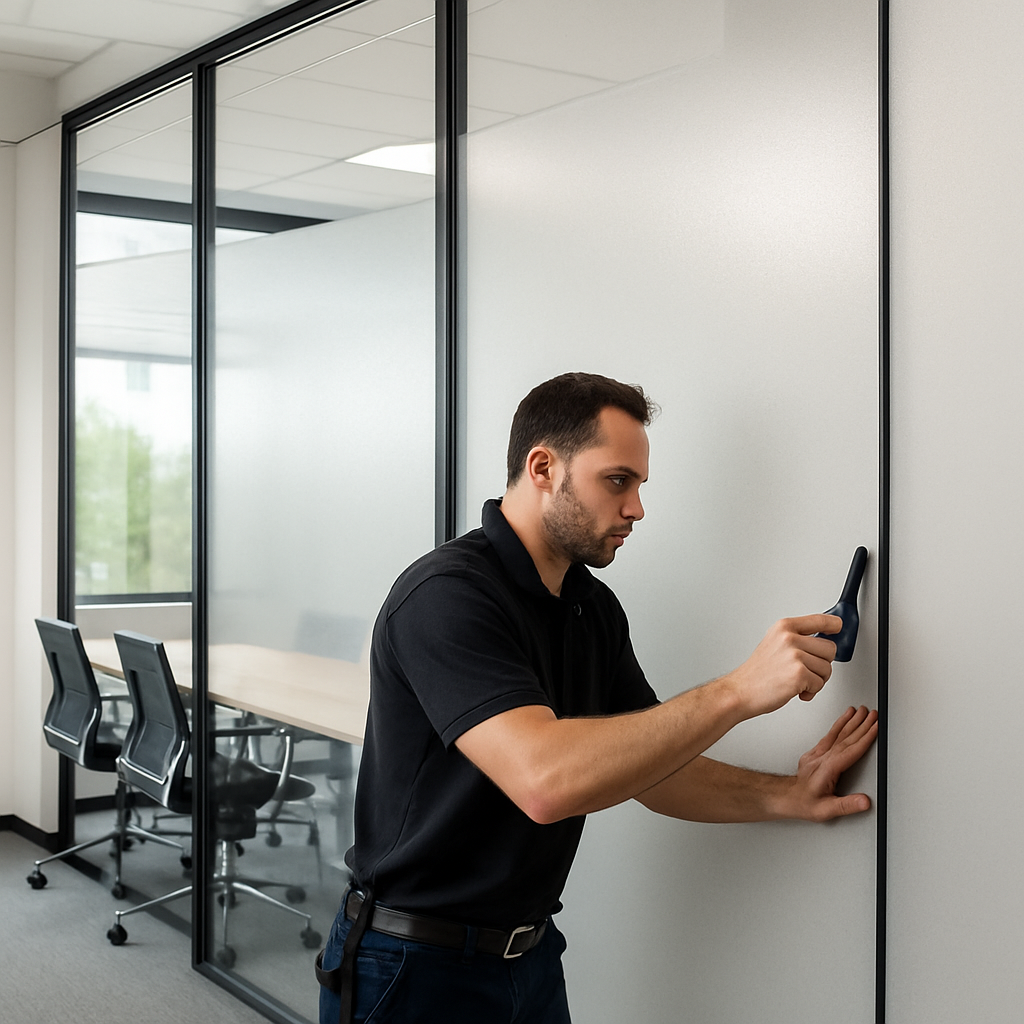
Installation and material judgment: For runs over 6 feet, choose cast adhesive films rather than calendered or static cling. Cast adhesives conform and hold edge-to-edge without lifting; static cling is fine for short-term fits or rentals but will look tired and can peel at the edges over time. Proper surface prep is non-negotiable: professional wet-application, panel-by-panel alignment, and edge clearance checks on tempered glass keep seams invisible and warranties intact.
Concrete example: In a Portland coworking office, a mid-size conference room with full-height glass was fitted with 3M Fasara matte. The frosted finish maintained daylight across the room, removed distracting sightlines during meetings, and met the client requirement for silhouette-level privacy. The installer used cast adhesive panels and matched seams so the finish read as continuous from 10 feet away.
Costs and scheduling: Material for stock frosted films is inexpensive relative to printed solutions; ballpark installed costs typically run lower than custom prints or switchable films. Expect most mid-size partition installs to be scheduled and completed within 1 to 3 business days, depending on site access and panel count. Get an itemized quote—labor and pattern matching drive the final price more than the film itself.
Practical limit: Frosted film does not improve acoustics or provide forced-privacy (for instance, in medical screening rooms or court-style confidentiality). If you need impact resistance or sound control, specify safety/security films or combine frosted film with acoustic solutions rather than assuming the decorative film will do both jobs well.
2. Patterned Geometric Films for Modern Design
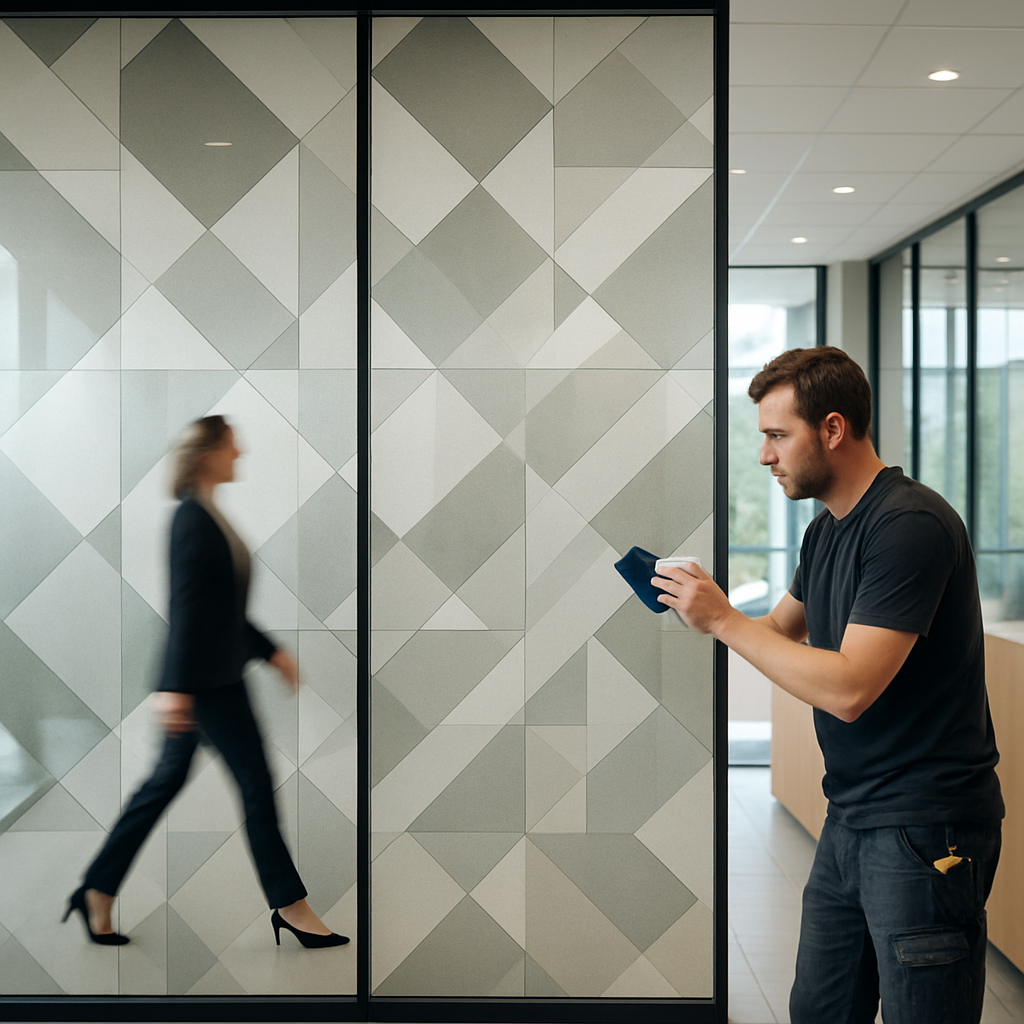
Direct design value: Patterned geometric films give glass partitions rhythm and visual hierarchy while keeping daylight; they are the go-to when you want a clear graphic identity without blocking light across an entire office. Use the phrase decorative window film for glass partitions when discussing scope with vendors so you get products and installation methods sized for interior glazed work, not exterior tinting.
Products to evaluate: Solyx decorative pattern films and 3M Fasara patterned etch options are stocked and come in repeatable motifs—hexagons, linear grids, chevrons—so you can test scale rather than ordering a full custom print. These are available as adhesive window film; for temporary needs ask about static cling window film variations.
How scale, density, and substrate change performance
Pattern scale matters more than most designers assume. Small, dense repeats read as near-opaque from distance and offer high privacy but create visual noise at close range; large, low-density motifs read as graphic and keep sightlines. That trade-off affects privacy window film performance and occupant comfort more than a simple percent light-transmission spec.
- Best use cases: reception backdrops, open-plan dividing screens, and large conference-wall features where the pattern can be scaled to panel height.
- When to avoid: small meeting rooms or narrow corridors—dense patterns can feel busy and interfere with wayfinding.
- Installation note: pattern-matching across adjacent panels increases labor and time; request pattern-alignment pricing separately so the quote reflects seams and layout work.
Concrete example: A Salem coworking space chose a Solyx large-hex pattern scaled to the full panel height on a 12-foot reception wall. From the lobby the geometry reads as a clean graphic while people inside still have daylight and a sense of depth; installers pre-aligned cuts in the shop to minimize on-site seam trimming and avoid stepped repeats visible from the street.
Practical limitation and trade-off: patterned window film is not a substitute for acoustic treatments or security films. Patterned decorative glass film improves visual privacy and aesthetics but can amplify glare or create distracting reflections depending on the finish. If glare control or safety is required, specify UV blocking window film or safety/security films alongside the patterned layer and plan for combined warranties.
Common mistake: teams pick visual samples on a desk and assume the effect scales; that fails in practice. Always request full-height mockups or ask the installer to apply a trial panel to confirm scale, viewing distance, and seam visibility before approving the entire run.
Test pattern scale at full height and viewing distance; small repeats increase privacy but often create visual fatigue in tight spaces.
3. Gradient and Ombre Films for Subtle Privacy
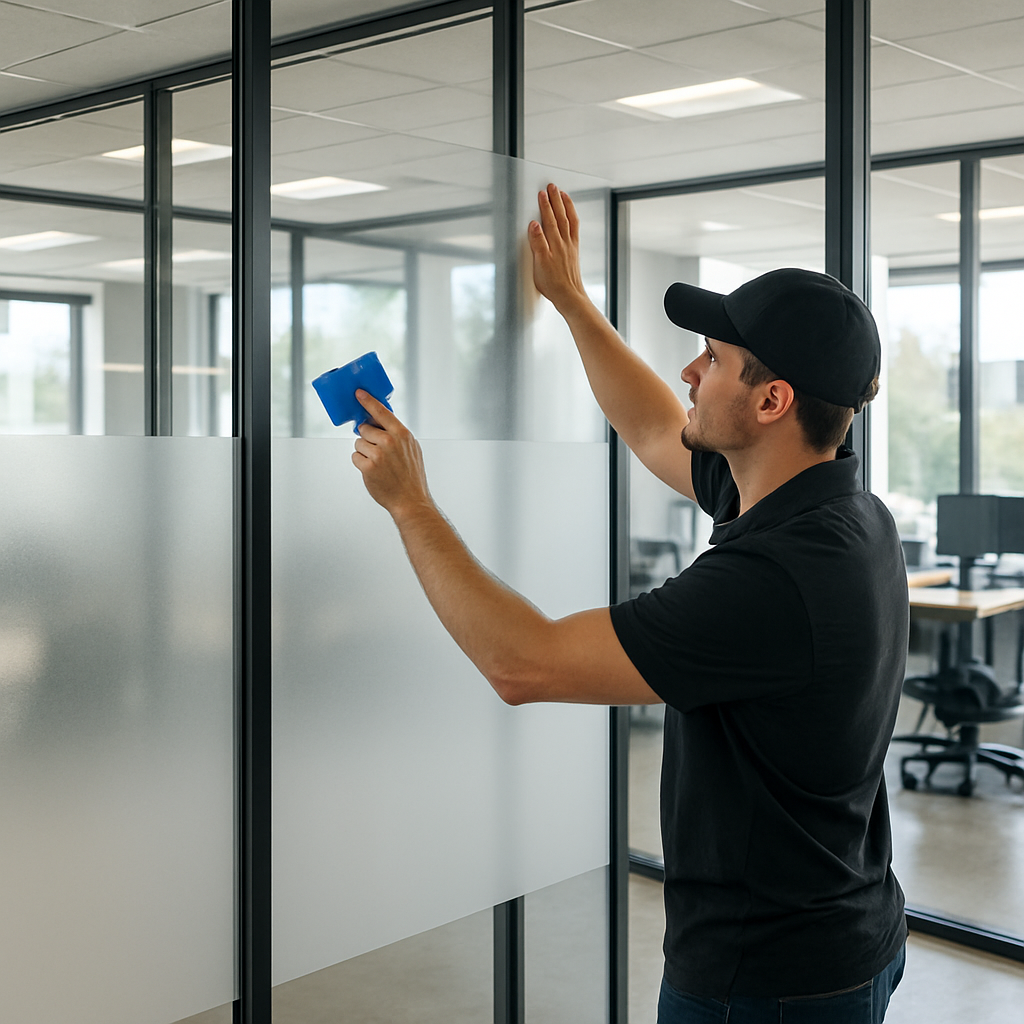
Bottom-up privacy without losing daylight. Gradient and ombre films fade from opaque to clear so you get screened lower sightlines while preserving skyward daylight and views. Typical products include stock gradient rolls from manufacturers like Solyx and semi-custom gradients offered by regional suppliers and installers who can match a specific fade length or color wash.
Trade-off to manage. Gradients are visually light and modern, but they are not a substitute for acoustic or security measures. In multi-panel runs a fade that crosses seams will read as stepped transitions unless panels are cut and aligned precisely in the shop. For any run over a few panels, insist on cast adhesive grades, not static cling, to avoid lifting at edges and to keep the fade continuous over time.
Installation and proofing matters more than you think. Ask for a full-height mockup or a shop-applied proof so you can confirm the rate of the fade and the perceived density from both near and far viewing distances. If you need color or brand tones in the fade, choose custom-printed gradient films with UV-stable inks and a protective laminate; that adds cost and requires a professional installer to avoid delamination and color mismatch under daylight.
Concrete example: A downtown Portland design firm used a right-to-left ombre on 8 full-height office partitions, moving from opaque at desk height to clear at eye level and above. The installer pre-cut continuous panels to avoid seams interrupting the fade, oriented each panel so the clear zone aligned with window views, and completed the install in a single afternoon for minimal disruption.
Common misunderstanding and practical judgment. Teams often pick a pretty sample and assume the fade will read the same in situ. In practice, short fades that finish too close to the viewing zone can feel like a bandage; long, gentle fades read as architectural and reduce visual fatigue. Also choose a matte finish when glare reduction is important; glossy ombres can create specular highlights under office lighting.
Where gradients work best
- Phone booths and focus pods: screen waist and chest height while keeping daylight above.
- Open-plan desks facing circulation: preserves openness but reduces direct sightlines into workstations.
- Conference room lower-field privacy: keep the top third transparent for daylight and projection placement.
- Reception counters and vestibules: add a soft transition from public to private without heavy branding.
Choose cast adhesive and request a full-height mockup. If you need brand color in the fade, budget for custom printing and lamination to ensure color stability.
4. Privacy Bands and Frosted Stripes for Compliance and Style
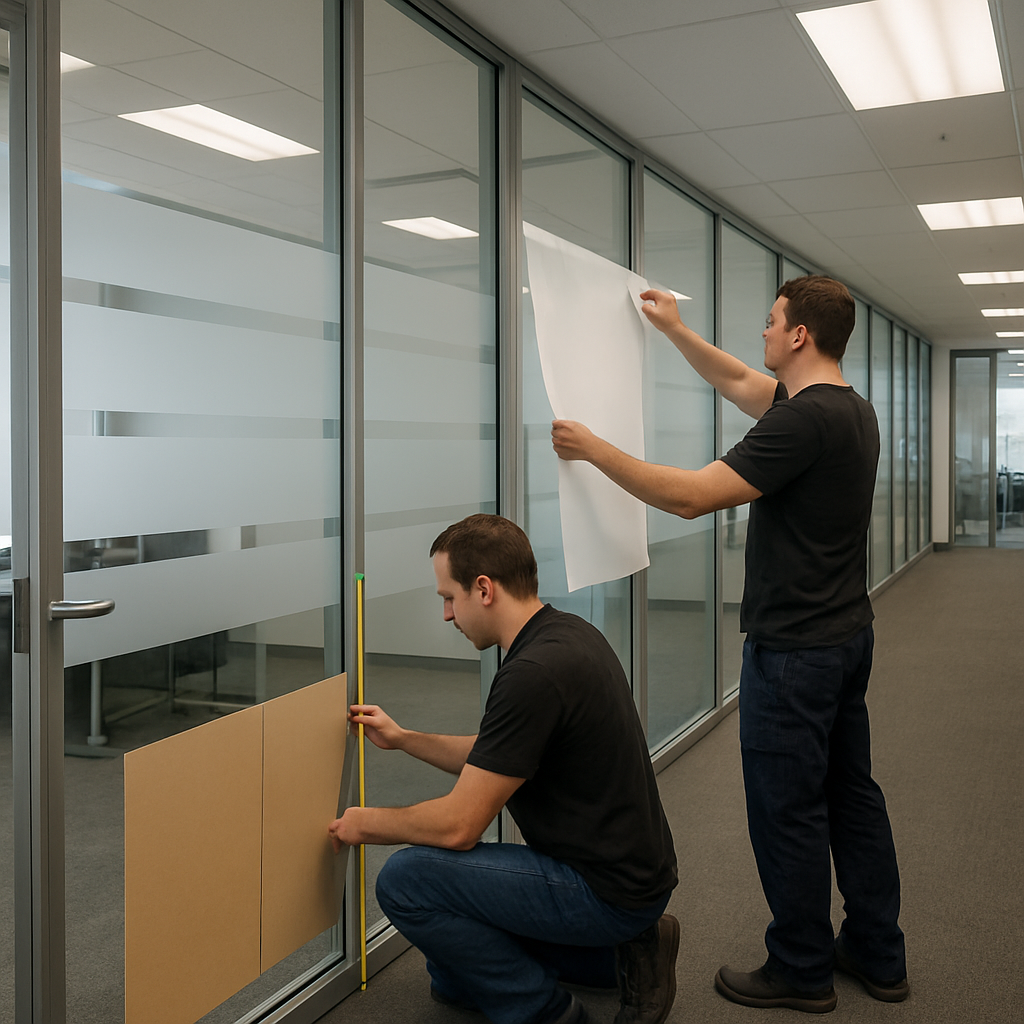
Straight to the point: privacy bands and frosted stripes are the pragmatic way to satisfy sightline requirements and keep daylight—while giving partitions a clean, repeatable graphic rhythm. Use decorative window film for glass partitions when you need legal visibility strips, coordinated offsets across multiple doors, or a branded horizontal datum without committing to full-panel graphics.
What they solve: bands control where people can see into a space and where they cannot, so they address both occupant comfort and many code-driven vision-panel expectations. They also reduce the visual clutter that comes from full-height frosting and are inexpensive relative to full custom prints or switchable systems.
Installation realities and trade-offs
Durability vs removability: choose cast adhesive decorative glass film for permanent banding on doors and egress routes; static cling window film looks tempting for flexibility but tends to lift at edges and usually won’t satisfy inspectors. Adhesive films hold up to touch, edge abrasion, and frequent cleaning—important where bands sit at hand level.
Alignment is the hidden cost: matching band heights across a run of panels multiplies cuts, edge tolerances, and labor. Narrow 2- to 4-inch stripes read crisp but require millimeter-level consistency across panels; wider bands hide small misalignments but change the visual weight of the design. Expect installers to charge extra for precision pattern-matching.
- Practical step: field-template every door and panel before cutting; tape templates prevent shop-cut mistakes.
- Material choice: pick adhesive window film with a protective wear layer for low-level bands that get touched frequently.
- Compliance tip: verify with your building official whether a removable film meets local vision-panel rules—many jurisdictions treat applied film differently than permanent glazing alterations.
Concrete example: a mid-size law firm in Salem needed consistent vision strips across ten full-height glass offices. The project used Llumar decorative bands installed by a certified crew who shop-cut panels to a common template, ensuring identical offsets and seamless visual alignment from the corridor. The result passed the facility inspection and reduced after-hours glare complaints without blocking daylight.
Practical judgment: bands are a cost-effective compromise—but they are not a substitute for acoustic, security, or anti-glare solutions. If privacy needs change over time, design the band placement so you can layer a printed or frosted panel later without redoing the entire run.
If you plan bands on doors or egress paths, default to cast-adhesive decorative films and require a field template—cheap mistakes happen when installers cut to desk samples instead of measured panels.
5. Custom Printed and Branded Graphics for Reception and Wayfinding
Clear outcome: custom-printed decorative window film for glass partitions turns reception glass into active wayfinding and brand real estate, but it changes more than aesthetics — it changes light, legibility, and maintenance needs. Treat the graphic as a small signage project, not just vinyl decoration.
Production realities and what to specify
Artwork and color control: submit vector logos and spot-color references; printers will ask for Pantone chips and normally convert to CMYK for print. White underprint is mandatory for opaque logo color on clear or translucent films — without it colors print washed out. For product lines see Solyx printable films (Solyx) and Avery Dennison printable window media (Avery Dennison).
- Material choice: pick translucent film for backlit depth or opaque film when you need solid color and high contrast.
- Finish: matte reduces glare and improves legibility for text and QR codes; gloss looks vivid but can reflect ceiling lights.
- Lamination: ask for UV-stable inks and a clear laminate to protect prints from abrasion and fading in sun-exposed lobbies.
Trade-off to accept: full-coverage prints block daylight. If preserving daylight is a priority, limit printed area to lower halves, use frosted backgrounds with printed accents, or select high-transmission translucent films. Branding wins can reduce perceived openness if you cover the entire panel.
Legibility rule of thumb: design typography for the viewing distance — roughly 1 inch of letter height per 10 feet of typical viewing distance for directional text. Small type and fine strokes look crisp on a monitor but fail from a corridor or when light contrast is low.
Install and warranty considerations: custom prints almost always require adhesive window film and professional wet application. Ask the installer to confirm edge clearances on tempered glass, provide a color proof or shop-applied mockup, and include lamination and warranty for outdoor-facing exposures. Removable or static cling prints are tempting for short-term campaigns but rarely hold up to heavy traffic or sunlight.
Example use case: A university reception desk in Eugene used Avery Dennison printable media with a white underlayer, UV-stable inks, and a matte laminate. Designers placed bold directional icons at 8 to 10 feet viewing distance and left the upper third clear; the result reinforced identity, made room numbers readable from the corridor, and kept enough daylight for the seating area.
Request a shop-applied proof and an on-site mockup before full production. Color on glass under daylight rarely matches file previews — this step prevents expensive reprints.
6. One-Way Vision and Perforated Films for Exterior-facing Glass Partitions
Key reality: perforated one-way vision films depend on lighting contrast, not magic. Micro-perforated decorative window film for glass partitions will read as a crisp graphic from the brighter side and a dark, semi-opaque surface from the darker side — flip the lighting and the effect reverses. Manufacturers like Avery Dennison and 3M sell purpose-built perforated films designed for applied graphics, but their performance will always hinge on interior vs exterior luminance.
Practical trade-off: you gain outward sightlines for occupants but sacrifice graphic resolution and some daylight. Perforated films reduce visible light transmission and render fine detail poorly; small type and thin strokes will vanish at normal pedestrian viewing distances. Expect strong brand marks and simple pictograms to work well, and photographic detail to look grainy unless printed at very large scale and viewed from a distance.
Concrete example: A storefront-facing office in downtown Portland applied Avery Dennison perforated film to interior partition glass that faces the street. During the day staff kept unobstructed views outside while passersby saw a branded panel; at dusk the installer recommended dimming interior accent lights and adding exterior lighting to maintain privacy. The team used cast adhesive panels, shop-cut seams, and a dusk test to confirm the effect across typical business hours.
Design and production judgment: opt for bold, high-contrast artwork and oversized typography when planning perforated prints. Request a printed proof and a shop-applied mockup because digital proofs rarely convey how dot pattern, viewing distance, and backlighting interact. If you need legible wayfinding or small text, move that content to a solid or frosted band adjacent to the perforated graphic rather than trying to squeeze detail into the holes.
Installation considerations that matter: use adhesive window film (cast adhesive for multi-panel runs) rather than static cling for longevity, align perforation orientation across panels, and test in-situ at different times of day. Also confirm tempered-glass edge clearances and cleaning routines with your installer so warranties remain valid.
When to pair perforated film with other solutions
- Combine with a frosted lower band when you need silhouette privacy at desk level while keeping outward views above.
- Add a safety/security film behind perforated graphics on partitions that require impact resistance or to meet local safety codes.
- Use UV-stable inks and a clear laminate for exterior-facing exposures to slow fading and abrasion on printed perforated films.
Test perforated films in real lighting conditions (day and night). If you skip this step you will see the effect reverse or lose privacy after hours.
7. Smart Switchable Privacy and Security Film Options plus Local Installation by Tinting Oregon
Direct point: Switchable privacy films deliver on-demand opacity that actually works in real office workflows, but they are a systems purchase — not a drop-in decorative option. Expect electrical work, control hardware, and a higher installed price compared with adhesive decorative glass films.
Products to review: PDLC/smart films from Smartglass International and Gauzy are the typical choices for interiors; pair those with tested retention films such as 3M safety and security window films for glass partitions when impact or fragmentation control matters. These product families are complementary rather than interchangeable.
What to expect in practice
Practical trade-offs: Switchable films require continuous low-voltage power and a control interface. When powered on they go clear but rarely match the crystal clarity of bare glass — expect a slight haze and a faint grid effect on larger panels. When powered off they become opaque quickly, which is great for privacy but creates a different visual mass in an open plan; that affects perceived daylight and can change how the space feels.
| Feature | Switchable (PDLC) | Safety/Security Film |
|---|---|---|
| Primary benefit | Instant clear/opaque control for meeting or AV needs | Glass retention and fragmentation reduction on breakage |
| Installation complexity | Requires electrician, controller, and edge termination | Simple adhesive retrofit but needs correct edge clearance |
| Typical maintenance | Electrical checks and occasional controller servicing | Periodic inspection for peeling or edge lift; cleaning only |
| Good fit for | Executive boardrooms, flex rooms, AV-equipped spaces | High-traffic corridors, healthcare screening rooms, storefront partitions |
Real-world example: Tinting Oregon installed a Smartglass International PDLC system in a Portland executive boardroom that needed instant blackout for AV and quick transparency for walkthroughs. The project required running power to the ceiling-mounted controller, integrating a wall switch and a table-top AV trigger, and installing a 3M safety film behind the PDLC to meet the client security brief. The combined install preserved sightlines when clear, gave reliable opacity for presentations, and satisfied the facility manager's safety expectations.
- Electrical and controls tip: budget for an electrician to run conduit, fit a transformer or control module, and add surge protection — control failure is the most common operational issue and the cheapest fixes are proactive.
- Combined solutions work better: for partitions that must both protect occupants and provide privacy, layer switchable film over a safety/security adhesive rather than treating the two as alternatives.
- Procurement blind spot: ask for total installed cost that includes demo/mockup, control hardware, electrician labor, and a warranty that covers both optical performance and the control electronics.
Switchable film is a systems decision: if you skip electrician quotes and control integration in the early budget, the project will overrun and deliver a subpar user experience.
