
If you are comparing places that do window tint across Portland, Salem, Eugene, or Bend, the quotes you get will look different and it will be hard to know which one is a good value. This practical guide shows what to demand from window tinting services, how to normalize quotes to a price per square foot, and which film performance metrics, warranties, and installer qualifications actually matter in the Oregon climate. Follow the checklists here and you will be able to shortlist reliable local window tinting shops and avoid common installation and warranty pitfalls.
Why careful comparison matters for long term performance and cost
Key point: Installer skill and the exact film specified determine long term results far more than the headline price. A high-end ceramic film installed poorly will show bubbling, edge lift, adhesive staining, or premature failure, while a mid-grade film installed by a competent, certified installer can deliver years of reliable performance.
Tradeoff to understand: Film choices are tradeoffs between visible light, heat rejection, and thermal performance. Lower VLT reduces glare and privacy issues but can make rooms feel darker; lower SHGC reduces cooling load but some low-VLT films do not improve winter thermal retention. In Oregon where winters are cool and summers have occasional heat spikes, prioritize films that improve U factor as well as reduce SHGC for year round comfort.
Concrete example: A Portland homeowner compared three quotes for west facing living room windows. The cheapest option used dyed film that dropped VLT to 15 percent and reduced glare but had negligible SHGC improvement; after one summer the room still overheated. The mid tier ceramic quoted delivered better SHGC and a documented manufacturer data sheet, produced a measurable afternoon temperature drop, and came with a registered warranty tied to installer certification.
Cost vs value insight: Normalizing to price per square foot is necessary but not sufficient. Watch for hidden cost items – removal of old film, travel charges, masking and edge sealing, and warranty registration fees. More important, verify whether the warranty is conditional on installer certification and on-time registration. A long warranty is only useful if it is honored and if the installer will stand behind labor for adhesive or edge failures.
What most buyers misunderstand: Many assume the best way to save is to pick the lowest quote. In practice low bids often cut corners on prep and edge finishing, or substitute cheaper adhesives. That increases the probability of callbacks, visible defects, and earlier replacement which raises lifecycle cost above a better documented mid tier option.
Practical priorities when comparing providers
- Demand the exact film model and manufacturer data sheet so you can compare VLT, SHGC, U factor, and UV rejection.
- See evidence of similar local installs older than two years including photos and a reference you can call.
- Confirm warranty registration process and whether the manufacturer warranty requires certified installer registration.
- Get removal and edge finishing included or priced separately and documented in the quote.
- Require a post install inspection window and contact for warranty claims so the installer cannot disappear after payment.

How to build a reliable shortlist of local providers in Portland, Salem, Eugene, and Bend
Start local but verify beyond star ratings. Google and Yelp surface the handful of places that do window tint near you, but review counts are noisy. Use listings to create an initial pool of 6 to 8 prospects, then narrow by evidence — documented local jobs, a working business address, and proof of insurance.
Shortlist steps you can execute in a single afternoon
- Search and capture. Pull Google Business Profiles, BBB entries, and Nextdoor recommendations. Save links and note whether each company shows local project photos in Portland, Salem, Eugene, or Bend.
- Trim to five. Remove any provider without a business address or current insurance paperwork (COI). For commercial projects remove providers that lack a commercial contractor number or refuse to provide a COI.
- Ask for three recent local references. Insist on installs at least six months old and in the same city or similar building type. Ask to see photos taken after one year if available.
- Request exact film spec and datasheet. No film model = no apples-to-apples comparison. If a shop hesitates, cross them off the short list.
- Check installer credentials. Prefer firms with manufacturer certifications or IWFA membership; single-operator mobile shops can be fine for small residential jobs but they rarely carry manufacturer-backed commercial labor warranties.
- Schedule on-site estimates within a single two-week window. Comparing quotes made from different seasons or without an on-site measure creates false differences.
Practical tradeoff: mobile window tinting is convenient and often cheaper for vehicles or a few house windows, but for larger residential facades and commercial glass choose a shop that can control dust, provide ladders/boom lift access, and handle complex edge finishing. You will pay more for that capability, but it lowers the risk of return visits and edge failures.
Concrete example: A property manager in Bend needed privacy film for six clerestory windows in a vacation rental. A mobile installer offered a low price but would not register a manufacturer warranty. A certified local shop quoted higher and supplied the exact film datasheet plus a signed COI and two local reference installs. The manager picked the certified shop because quick turnovers and guest complaints would have cost more than the price difference.
What most people get wrong: They equate many positive reviews with installer competence. In practice, cross-check reviews with requested documentation — datasheets, warranty registration confirmation, and photos of similar installations — before you trust a review score.
Film types, major brands, and the performance metrics you must request
Start with the exact model, not the marketing name. When you contact places that do window tint, insist the quote lists the precise film model and attaches the manufacturer technical data sheet. Brand names matter because they link the quoted film to specific test results and a warranty path; vague descriptions like premium, dark, or high-performance are useless for comparison.
How metrics translate to what you actually feel and pay for
Know what each metric means in practice. Visible light transmittance (VLT) affects daylight and how bright rooms feel; solar heat gain coefficient (SHGC) is the single best predictor of cooling load reduction; total solar energy rejected (TSER) tells you how much incident energy the film blocks overall; U-factor improvement indicates winter thermal savings on single-pane or poorly performing windows; UV rejection protects interiors from fading. Ask for the data sheet values for each metric for the exact film model being quoted.
Prioritize differently by exposure. For west- or southwest-facing glass in the Willamette Valley, prioritize lower SHGC and high TSER to cut afternoon heat spikes. For north-facing or display windows where color and daylight matter, keep VLT high while chasing TSER and UV rejection. That tradeoff — heat control versus retained daylight — is the single decision that separates useful installs from disappointed customers.
| Film Type | Typical Use Case | Practical tradeoffs |
|---|---|---|
| Dyed | Basic glare control and privacy for budget residential jobs | Good initial appearance but color can deepen and performance drifts with age; limited SHGC improvement |
| Metalized | Commercial facades needing stronger heat rejection and reflectivity | Better SHGC and TSER than dyed but may alter reflections and can interfere with radio/GPS signals |
| Ceramic | High-performance residential and commercial where optics and heat control both matter | Stable optics, strong SHGC/TSER without metal interference, higher cost and variable availability |
| Hybrid / Multi-layer | Balanced performance for mixed-use spaces | Combines dye/metal/ceramic features; performance varies by exact layering—verify datasheet |
| Safety / Security | Laminated film for glass retention after breakage | Adds safety and some thermal benefit but requires different warranties and installation methods |
Major brands to request explicitly. When you gather quotes, ask whether the film is from 3M, Llumar (VISTA), Huper Optik, Solar Gard, or equivalent manufacturer and request the manufacturer datasheet link or PDF. A well-known brand does not guarantee a flawless install, but it does provide accessible lab reports, clearer warranty procedures, and trained installers you can verify through the manufacturer.
Real-world application: A small Portland office had late-afternoon glare that made computer screens unreadable. Two quotes arrived: a dyed film that darkened the space and a ceramic film that kept daylight while dropping window heat. The ceramic option required a higher upfront payment, but the property manager accepted it because staff productivity recovered and AC runtime fell during peak weeks.
A critical installer-level tradeoff. Some installers will quote a specific ceramic model but substitute a visually similar hybrid on the day of install to save cost. Protect yourself: require the film roll label number on the invoice, photograph the label at delivery, and demand that the installer register the product warranty in your name. If the installer resists these steps, consider that a red flag.

How installers typically price jobs and how to normalize quotes
Straight to the point: most quotes are built from three levers — the film itself, labor structure, and job complexity — and those hide the real comparison points you care about. Film price varies by chemistry (dyed, metalized, ceramic), installers bill either by square foot or by flat job/minimum, and complexity items (old-film removal, scaffolding, edge finishing, access time) create fixed charges that skew small-job math.
Quick normalization workflow
- Collect the line items: insist the quote shows total square footage and breaks out materials, labor, removal, travel, and permits.
- Compute raw rate: divide the quoted total by the quoted square footage to get a baseline $/sq ft.
- Allocate fixed fees: convert removal, travel, and minimum charges into a per-square-foot amount by dividing them across the same square footage to get an effective $/sq ft.
- Adjust for warranty and registration: note whether manufacturer warranty registration and certified-installer labor warranty are included; treat missing warranty coverage as a risk-cost.
- Compare apples to apples: create a small table listing effective $/sq ft, included services, and the exact film model (attach datasheet) before choosing.
Practical limitation: $/sq ft only tells part of the story. A low per-foot rate on a small job often reflects a large minimum or omitted removal that shows up as higher total cost or failure risk later. For larger façades, per-foot rates drop because roll waste and set-up are amortized; expect the math to favor larger contiguous areas.
| Quote | Stated Price | Sq ft | Raw $/sq ft | Extras (removal, travel) | Effective $/sq ft | Warranty / Cert |
|---|---|---|---|---|---|---|
| A (low bid) | $2,200 | 220 | $10.00 | $450 | $12.05 | No manufacturer registration |
| B (mid tier) | $3,600 | 360 | $10.00 | $0 (included) | $10.00 | Registered, certified installer |
| C (small job) | $1,250 | 80 | $15.63 | $200 | $18.13 | Short installer labor warranty |
Concrete example: a Portland homeowner quoted A, B, and C above would see quote A appear cheapest until removal and absent warranty are added, pushing its effective cost above B. The mid-tier B provides the best lifecycle value because it includes removal and requires installer certification for the manufacturer warranty — that matters if adhesive or edge failure appears in year two.
Judgment you won't get from a sales rep: pay attention to how installers charge for complexity. High windows, multi-pane IG units, and safety film all add time and technique; cheap installers often underprice those and then either cut corners or bill change orders. I recommend paying a modest premium for firms that document assumptions and list change-order rates up front.
Installer qualifications, manufacturer certifications, warranties, and insurance to verify
Start from contracting reality: the installer and their paperwork determine whether a warranty matters and who fixes problems after payment. A clear certificate of insurance and a signed labor warranty matter more than a sales pitch about brand names.
Certifications that actually matter
Manufacturer installer programs and formal associations. Look for installer certification from the film maker for the exact product being quoted and for third-party affiliation such as the International Window Film Association (IWFA). Certification is not a guarantee, but it signals trained crews, documented procedures, and faster support on warranty claims.
Context matters. For a single-car window or one residential sash, a skilled independent tech with good references can be fine. For large facades, safety film, or multi-pane IG units prefer shops with documented commercial experience and manufacturer-backed labor warranties.
How to read warranties so they are useful
Distinguish manufacturer coverage from installer labor coverage. Manufacturer warranties typically cover film delamination, bubbling, or discoloration for a stated period but often require product registration and a certified installer. Installer labor warranties cover workmanship – edge lift, poor adhesion, and improper finishing. Get both in writing.
Watch the exclusions and the claims process. Common exclusions include damage from abuse, abrasive cleaners, or altered glass. Ask who registers the warranty, how long you have to report problems, and whether the warranty transfers if you sell the property. Request a sample warranty PDF before you sign.
Insurance thresholds and proof to request
Minimum proof to require. Ask for a current certificate of insurance showing general liability and workers compensation. For most residential and light commercial jobs, a $1,000,000 general liability policy is reasonable; for larger or high-access jobs require higher limits and that the client be added as additional insured.
Mobile shops and single operators are different risks. If a mobile installer will be working from ladders, lifts, or on a busy storefront, insist on evidence they carry commercial auto and adequate liability. If they cannot produce a COI on the spot, do not schedule a job that risks property damage or public safety.
- Quick verification checklist: Request these at the estimate – COI with limits, sample manufacturer warranty PDF, proof of installer certification for the quoted film, name of the person who will register the warranty, written installer labor warranty length and scope, and a photo of the film roll label to confirm the model at delivery.
Concrete example: A Eugene retail owner accepted a low mobile quote to add privacy film. During install the crew used a scaffold but had no COI listing the property owner as additional insured; a fallen tool cracked display glass and the owner ended up paying the deductible and dealing with replacement. A certified shop had quoted higher but would have handled the claim directly and absorbed repair logistics.
Next consideration: schedule estimates only with installers who will produce the requested documents either in person or by email before any deposit is paid. That step reduces your downside and makes comparing quotes meaningful.
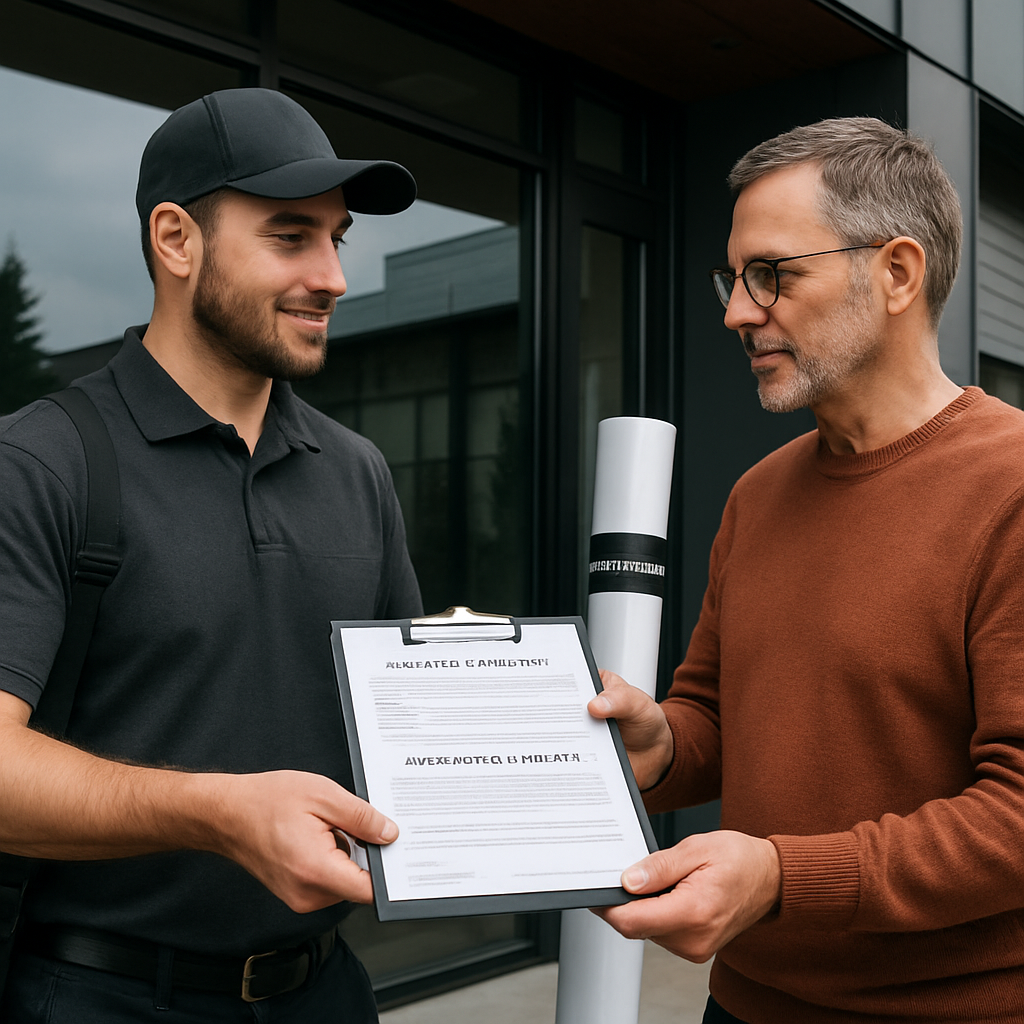
On-site estimate checklist and 12 specific questions to ask every provider
Be prepared to run the estimate like a short audit. The on-site visit is where quotes stop being vague promises and become verifiable commitments. Require the estimator to measure, show samples, document conditions, and produce an itemized written quote you can evaluate later.
On-site checklist (what to make them do)
Measure and photograph. Have the estimator record measured square footage, window IDs (label each opening), and photos of glazing conditions including any edge damage, seals, or existing film.
Produce physical proof. Insist they bring an actual film sample and a printed manufacturer technical data sheet for the exact model they plan to use. No datasheet on site = no quote.
Walk through assumptions. Ask them to point out prep work (cleaning, old-film removal), access needs (lifts, scaffolding), expected cure time, and any conditions that would trigger a change order.
Write it down on the spot. Request an on-site provisional quote with square footage, unit rates, fixed fees (travel, minimum), warranty registration responsibility, and an estimated start/finish window.
Confirm paperwork. Before you leave the visit, get a promise to email the COI, sample warranty PDF, and the film roll label photo when materials arrive. If they refuse, consider that a red flag.
12 specific questions to ask — get answers on record
- Exact product: What is the precise film model and batch or roll label you will install?
- Performance values: Can you show VLT, SHGC, TSER and UV rejection from the manufacturer datasheet for that model?
- Installer credential: Are the installers certified by the film manufacturer for this model and can you provide proof?
- Warranty specifics: Who registers the manufacturer warranty, and can I see the warranty PDF now?
- Labor coverage: What does your installer labor warranty cover, how long does it last, and is it written?
- Removal policy: Will you remove existing film or coatings? If so, what is the separate cost and how do you document glass condition afterward?
- Edge treatment: How will you finish cut edges and penetrations, and do you recommend edge sealing for this job?
- Adhesion check: How do you test adhesion during and after install and how long is the cure period before cleaning?
- Access and safety: What equipment will you use, who is responsible for permits or third-party access, and do you carry a COI naming the client as additional insured if requested?
- Timing and staging: When can you start, how many days will it take, and will you phase work to prioritize critical exposures?
- Change orders: How are unforeseen issues priced and approved, and will you provide change-order estimates before additional work?
- References and inspection: Can you provide two recent local references for the same film/model and a post-install inspection contact?
Practical tradeoff to keep in mind: A shop that answers every question confidently and produces paperwork on site will usually cost more, but those up-front costs reduce the probability of callbacks and warranty fights. Cheap, vague bids save money now and cost time and hassle later.
Concrete example: A Salem small-business owner had two on-site visits. Vendor A arrived with printed datasheets, photographed each pane, and emailed a COI immediately; Vendor B emailed a high-level estimate and refused to show roll labels. Vendor A charged more but the owner avoided a surprise removal charge and had a documented warranty registration when edge lift appeared in year two.
Bring a checklist and insist on photographic proof of the film roll label and a sample datasheet before you authorize deposit.
Comparing quotes, factoring ROI, and negotiating without sacrificing quality
Direct point: Price per square foot is a starting metric, not a decision. You must convert quotes into a weighted comparison that combines effective $/sq ft, documented film performance, and measurable risk reductions such as labor warranty coverage and written acceptance criteria.
Quick ROI checklist
- Normalize price: Include material, labor, removal, travel, and any minimum fee and express as effective $/sq ft.
- Map performance to benefit: Use the quoted SHGC change for the exact film model to estimate cooling load reduction for the glass area in question.
- Estimate energy savings: Multiply expected percent cooling reduction by current annual cooling cost for the conditioned space to get annual dollar savings.
- Adjust for non-energy benefits: Value glare reduction, privacy, and UV protection separately; these are often decisive but not in the energy ROI.
- Include warranty and labor risk: Treat missing manufacturer registration or short labor warranty as a cost that increases replacement probability.
Practical limitation: ROI math is only as reliable as your usage assumptions. If the building rarely runs AC, projected cooling savings will be small and payback will rely on non-energy benefits. In mixed climates like Oregon, weigh U factor improvements for winter comfort as well as SHGC for summer.
Concrete example
Example: A homeowner in Eugene has 180 sq ft of west facing glass. Quote A (dyed) is $1,200 and yields SHGC 0.65, Quote B (mid ceramic) is $1,800 and yields SHGC 0.35. If current annual cooling costs attributable to that exposure are about $400, the ceramic reduces solar gain roughly 40 percent more than the dyed option, suggesting roughly $160 per year in cooling savings. The incremental spend of $600 divides into a simple payback of about 3.75 years — and that ignores productivity and glare benefits which are often the real win.
Judgment that matters: Low bids often omit the cost of callbacks. I prefer a mid-tier film with a documented manufacturer dataset and a signed installer labor warranty because the lifecycle cost and headaches are typically lower than chasing the cheapest headline price.
Tactics to negotiate without cutting quality
- Phased install: Start with the highest-heat exposures. Use measured temperature and occupant feedback to validate performance before committing to the full job.
- Ask for options: Request line-item pricing for two film tiers and for the installer to hold the quoted price for 30 days so you can compare with other bids.
- Value swaps: Propose a modest deposit, with the final 10 to 15 percent retained until a 30 day post-install inspection and documented acceptance.
- Service concession: Negotiate one included service visit in year one to address edge finishing or adhesion tweaks rather than cutting warranty length.
Tradeoff to accept: Pushing installers to lower their quote usually reduces either prep quality or warranty scope. If you must cut cost, prioritize keeping the manufacturer warranty and the installer labor warranty intact and trim cosmetic add-ons instead.
If a shop will not provide two film options, a written itemized quote, or a short phased plan, treat that as a negotiation failure not just a pricing difference.

How Tinting Oregon fits into your evaluation and next steps to get estimates
Straight answer: treat Tinting Oregon as a local, full service reference point you can use to benchmark other bids, not just another line item on a quote list. They offer on-site estimating across Portland, Salem, Eugene, and Bend, can produce manufacturer paperwork on demand, and will register warranties and provide COI documentation — all of which materially reduces follow-up risk compared with undocumented mobile bids.
What to ask Tinting Oregon for during your estimate
- Exact film code and PDF datasheet: ask for the manufacturer model code and the technical sheet for the quoted film so you can compare SHGC, VLT, U factor, and UV rejection.
- Photograph of the roll label on arrival: require a time stamped photo of the film roll label at delivery and that label referenced on the final invoice.
- Warranty registration confirmation: request a copy of the manufacturer warranty registration email or confirmation number showing your property as the registered site.
- Itemized line item quote: insist the quote breaks out materials, labor, removal, travel, and any minimums so you can compute effective $/sq ft.
- Post-install service visit included: ask for one complimentary inspection within 12 months to confirm adhesion and edge finishing before final payment is retained.
Practical tradeoff: you will usually pay a small premium to work with a full service local company that documents and registers warranties. That premium buys two things that cheap bids rarely provide: easier claims resolution and lower likelihood of callbacks. If immediate same day service is critical for a single automotive tint or a handful of windows, a mobile tech can be fine; for whole-facade residential or commercial work pick the documented option.
Limitation to plan for: during peak summer months turnaround windows tighten. If you need a staged install or phased pricing, schedule estimates and lock pricing within a two-week window to avoid material or labor seasonal spikes. Also expect small travel or access fees for outlying properties in Central Oregon; confirm any travel charge up front so you can normalize quotes.
Concrete example: A Lake Oswego boutique needed UV protection for display windows before a product launch. Tinting Oregon provided an on-site estimate the next day, attached the exact manufacturer datasheet, photographed the roll label at delivery, and emailed the warranty registration confirmation after install. The storeowner compared that packet to two other bids and picked the mid-tier ceramic option because the warranty registration and documented roll label removed the uncertainty other vendors left unresolved.
Judgment that matters: the single most practical filter in your shortlist is not the lowest dollar figure but who will document and stand behind the work. When comparing places that do window tint in Oregon, give disproportionate weight to a provider who will produce verifiable roll labels and a registration confirmation in your name. That documentation is where most disputes get resolved quickly or become expensive headaches.
