

Window Film Energy Rebates in Oregon: How to Qualify, Apply and Maximize Savings
If you are weighing window upgrades, window film energy rebates Oregon can significantly reduce your upfront cost by covering qualifying solar-control films that lower solar heat gain. This guide explains how to check eligibility with Energy Trust of Oregon and your utility (Portland General Electric or Pacific Power), choose products and installers that meet program rules, assemble required documentation, and avoid the common mistakes that delay or void payments. For hands-on help, request a free on-site assessment from Tinting Oregon and we will walk the measurement, preapproval and paperwork process with you.
How Window Film Reduces Energy Use and Which Film Types Utilities Prefer
Direct point: Window film lowers cooling loads by cutting solar heat gain at the glass, and utilities almost always reward measures that demonstrate that reduction with verifiable performance data.
How performance is measured in plain language
SHGC and VLT explained: SHGC (solar heat gain coefficient) is how much solar heat gets through the window; lower is better for cooling. VLT (visible light transmittance) is how much daylight passes through; higher keeps interiors bright. Utilities want a clear numeric change in SHGC (or percent reduction) from baseline glazing — that delta is what drives incentive eligibility.
- Spectrally selective films: cut infrared heat while keeping visible light. Preferred by utilities because they reduce SHGC without darkening rooms much. Examples: 3M Prestige series, LLumar CTX/AirBlue.
- Reflective/metallic films: strong heat reduction but lower VLT and can trigger aesthetic or historic-district issues. Some programs accept them for commercial sites but they require explicit documentation.
- Dyed films: cheaper, reduce glare but perform poorly on SHGC; rarely meet rebate thresholds alone.
- Low-emissivity (low-E) retrofit films: aim to reduce heat transfer in winter and summer; eligibility varies and you must show lab data demonstrating net energy benefit.
Practical trade-off: If your goal is utility rebate plus livable interiors in Oregon, choose spectrally selective film. Darker, reflective films deliver bigger raw SHGC drops but cost you daylight and often complicate approvals in historic neighborhoods or by HOAs. Utilities focus on measured performance, not marketing claims — so manufacturer lab/NFRC-style data is non-negotiable for incentives.
Limitation to watch: Window film delivers the most value on glazing with high solar exposure — west and south facades. On north-facing windows or small single-pane windows with low solar gain, the measured energy benefit may not meet rebate program thresholds and installation could fail inspection.
Concrete example: A downtown Salem storefront with large west-facing panes installed spectrally selective film (LLumar CTX). The contractor provided manufacturer test sheets and an NFRC-style report showing a meaningful SHGC reduction; the utility accepted the documentation, the store reduced peak cooling demand and occupant comfort complaints dropped markedly. The project qualified for a utility rebate because the documented SHGC delta met program criteria.
If you want the technical reports before you commit, ask your installer for the exact product line and model and check the NFRC database or the manufacturer cut sheet. For program specifics see Energy Trust of Oregon and consult NFRC at NFRC. For local, practical guidance and on-site assessment see our diagnostic walkthrough at Should I be Window Tinting my home or business?.

Which Oregon Rebate Programs Cover Window Film and Who Is Eligible
Direct answer: Window film is commonly eligible under Energy Trust of Oregon and the major investor-owned utility programs that operate in Oregon, but eligibility depends on your utility service territory, building type and whether the project meets program documentation and installation rules.
Primary programs and how they interact
- Energy Trust of Oregon: Administers many residential and commercial efficiency incentives and is the primary pathway most installers use for window film rebates in Oregon. Check current measure lists and preapproval requirements at Energy Trust of Oregon.
- Portland General Electric (PGE): PGE customers typically access rebate offers either directly through PGE or via Energy Trust programs. Confirm your eligibility on the PGE rebate page: PGE rebates and incentives.
- Pacific Power: Pacific Power customers also participate in utility or Energy Trust-administered programs; commercial customers frequently qualify for custom incentives and higher per-project funding. See Pacific Power energy savings.
Key eligibility drivers: Service territory is the deciding factor — look at the electric account on your bill. Programs distinguish between single-family, multifamily (owner-occupied versus tenant units), and commercial buildings. Most rebates require professional installation by a participating or licensed contractor and often require preapproval or a reservation before work begins.
Practical trade-off: Residential prescriptive rebates are simpler but capped and targeted at standard products; commercial projects can access larger custom incentives but will be asked for baseline energy use, modeled savings, and sometimes a detailed cost-effectiveness study. If you have a small storefront, expect extra paperwork for custom funding but also a higher per-square-foot incentive.
Tenant vs owner rules: If you rent or manage a multi-tenant building, you must check who is the account holder on the electric bill and whether the program accepts landlord-initiated upgrades. Many programs allow incentives for common-area improvements but restrict incentives paid directly to tenants for unit-level work.
Concrete example: A commercial storefront in Salem on a Pacific Power account pursued a custom incentive — the installer submitted baseline glazing area, proposed film performance data and an estimated savings model. Pacific Power required a post-install inspection and paid a higher incentive after verifying measured savings; the extra documentation added three weeks but increased the rebate enough to shorten payback materially.
Common misunderstanding: People assume Energy Trust handles every rebate and that preapproval is optional. In practice, some utility-administered offers require reservations through the utility first, and skipping that step can disqualify payment even if the film would otherwise meet technical specs.
Next step: Confirm your utility using the bill lookup on Energy Trust of Oregon or visit the PGE and Pacific Power pages above, then schedule a site assessment with a contractor experienced in rebate paperwork, such as performing preapproval submissions and assembling NFRC-style product documentation. For a practical decision guide, see our assessment page: Should I be Window Tinting my home or business?.

Step by Step Application and Installation Workflow
Straight to the point: a rebate-compliant window film project is a process, not a single job. Treat it as six controlled steps—site assessment, incentive reservation, product documentation, ordered installation, verification, and payment—and you avoid the typical paperwork rejections and inspection delays that cost time and money.
Onsite prequalification and measurement
What the contractor must record: measure visible glass area (exclude frames), note pane count and glazing type (single, double, low-e), and map orientation by elevation (north/south/east/west). Utilities care about glass square footage by orientation because savings are calculated against solar exposure.
Practical insight: use a laser measure and photograph each window with a measurement tag in the frame. Simple rounding errors are a common reason rebates are adjusted down; report measured square footage to one decimal place and keep the raw measurement photos.
Reserve the incentive (when required) and plan timing
Reserve before you order product when the program asks for it. Some Energy Trust or utility pathways require a reservation or preapproval before installation; skipping this step risks losing the incentive even when the work otherwise complies. Confirm reservation windows—some programs hold funds only for a limited period.
Product selection and documentation package
Assemble exact product evidence: manufacturer performance sheets, NFRC-style test reports or lab certificates with SHGC or solar heat gain reduction numbers, product model numbers, and manufacturer contact. Generic marketing brochures will get rejected; programs want verifiable test data.
Judgment that matters: insist on a lab report referencing test standards (NFRC or ASTM) and listing the test conditions. Experienced installers can supply these quickly; less experienced vendors often produce only glossy cut sheets that slow approvals.
Installation, invoicing and installer responsibilities
Installer must provide a detailed invoice: line item for film (model and square footage), labor, installation date, business license, and W9 or tax ID if requested. Include before and after photos keyed to window labels used in the measurement map.
Trade-off to consider: faster installations sometimes skip photo tagging or precise labeling; that saves an hour on site but risks failing inspection and delaying rebate payment. Plan for 1–2 extra hours per site for documentation.
Verification, inspection and payment
What inspectors check: matching model numbers, measured vs invoiced square footage, existence of the required lab reports, and clear before/after photos. Expect a physical or virtual inspection in the weeks after submission; be ready to supply original lab files and installer credentials on short notice.
Common delay: mismatched model numbers between the invoice and the lab report. Always cross-check document filenames and the product code printed on the invoice before submission.
- Step 1: Contractor does onsite measurement and photos, produces a window map.
- Step 2: Reserve incentive or request preapproval from the program (if required). See Energy Trust of Oregon.
- Step 3: Choose qualifying film and collect NFRC-style test reports and manufacturer sheets.
- Step 4: Schedule installation, ensure installer will produce a detailed invoice and before/after photos.
- Step 5: Submit rebate application with all documents and participate in post-install inspection.
- Step 6: Receive rebate payment and reconcile with project accounting.
Concrete example: A Portland homeowner with 220 sq ft of west-facing glass booked a site assessment, the installer reserved the rebate slot, installed a spectrally selective film, submitted the NFRC-style lab report plus a tagged photo set, and the utility issued payment eight weeks after inspection. The key was matching the model number from the lab report to the invoice exactly.
Quick rule: use a contractor experienced with Energy Trust and local utilities; it reduces rework, paperwork mismatches, and inspection friction.

Next consideration: before you sign a contract, ask your installer to walk you through their typical rebate submission packet and to name the exact documents they will supply; if they hesitate, treat that as a red flag and consider a contractor who routinely handles rebate paperwork, such as the teams at Tinting Oregon referenced in our service pages like Should I be Window Tinting my home or business?.
Documentation Checklist for Window Film Energy Rebates
Start assembled, not scattered. Utilities and Energy Trust process applications fastest when documents arrive as a single, labeled packet that maps each file to the rebate requirement.
Core documents to collect before you apply
- Completed rebate application form — the program form filled out with property owner signature; include preapproval or reservation number if you have one.
- Installer invoice (line‑itemed) — separate line for film material and labor, install date, total area (sq ft), unit price and final paid amount.
- Manufacturer product data sheet — shows product name/model, spectral numbers, and numeric SHGC or solar heat gain reduction and VLT (visible light transmittance).
- Test report or NFRC style certificate — lab test reference or NFRC report where available; if the product lacks an NFRC label, include manufacturer lab test and lab accreditation details.
- Before and after photos — clearly labeled, taken from the same vantage points, showing measurable coverage of film on targeted glazing and visible date stamps.
- Window schedule or measurement worksheet — for each treated opening include address, room, orientation (N/S/E/W), width, height and calculated area.
- Contractor credentials — company name, business license, W9 or tax ID, proof of professional installer status and contact info for the installer who signed the invoice.
- Proof of payment — copy of cleared check, credit card receipt, or bank statement line that ties to the invoice amount (redact unrelated financial info).
- Preapproval or reservation correspondence — emails/screenshots confirming approval or reservation, if program required it before install.
- Post‑install inspection report or checklist — if the installer performed a self‑inspection, include that; otherwise, leave space to append the utility inspector report.
Practical trade‑off: NFRC rated reports reduce rejection risk but narrow product choices and add cost. If you pick a spectrally selective film without an NFRC label, expect to supply detailed lab reports and a stronger installer certification to pass validation.
Concrete example: A homeowner in southeast Portland had 420 sq ft of south‑facing glass treated. The installer provided a one‑page cover sheet that listed the rebate form, a 3M Prestige datasheet with SHGC numbers, the signed invoice with area math, and six paired before/after photos. The utility approved the package within three weeks because everything was labeled and the NFRC style test citation matched the product name on the invoice.
How to package files for fastest processing
- Create a single PDF named with property address and date.
- Start with a one‑page cover that lists each included document and the rebate item it satisfies.
- Use file names that match the cover (e.g., Invoice1234ElmSt.pdf, Datasheet3MPrestige.pdf, Photos_BeforeAfter.pdf).
- If submitting by email, include the property address in the subject and body and cc the installer who can vouch for accuracy.
Final consideration: Prepare this packet before installation when preapproval might be required, and ask your contractor — for example during the Tinting Oregon assessment — to deliver the completed, labeled PDF so you avoid resubmission delays and speed payment.
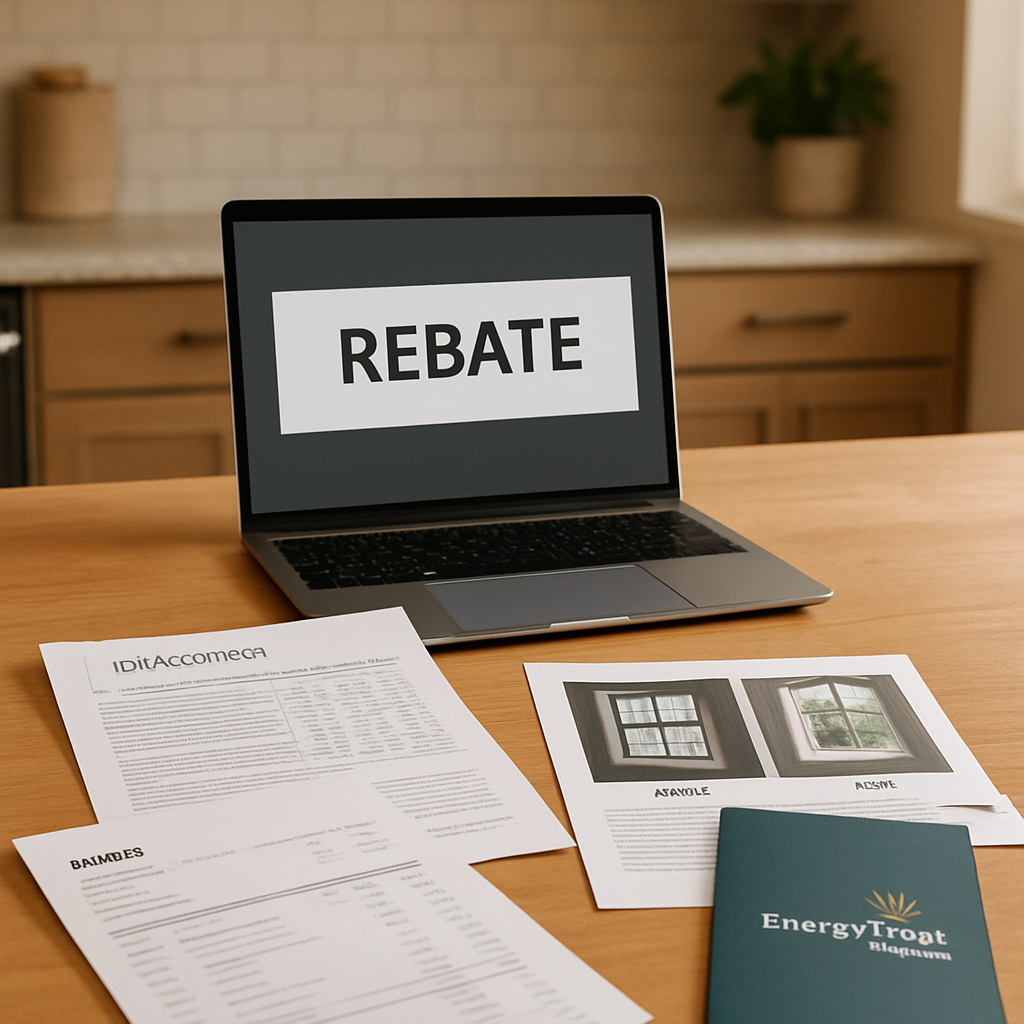
How Tinting Oregon Supports Rebate Success
Direct support for paperwork and technical data. Tinting Oregon doesn’t just install film — we assemble the manufacturer performance sheets, NFRC-style lab reports or equivalent test data, and the specific product model numbers utilities ask for, then format them to match Energy Trust or utility application templates.
Practical hands-on services that matter. We provide free on-site measurements in Portland, Salem, Eugene and Bend; recommend films that meet program thresholds (for example spectrally selective films from 3M or LLumar); create line-item invoices that separate materials and labor; and submit preapproval or reservation requests on behalf of the customer when programs require it.
A real failure mode to watch: incomplete test data. Utilities commonly reject claims where performance numbers are vague or lack a testing lab reference. Our judgment: the single most common cause of delayed or denied rebates is missing or improperly formatted product documentation — not installer quality or the film itself.
Concrete Example: A downtown Portland storefront had 850 square feet of west-facing glass. We measured, specified a spectrally selective film with documented SHGC values, submitted a preapproval packet to Energy Trust, performed the installation, coordinated the post-install inspection and the client received the rebate within eight weeks. Without the preapproval packet and lab reports we provided, the application would likely have been held for clarifications and delayed.
How we reduce friction during the rebate process
- Preapproval handling: submit reservation requests and preapproval packets to Energy Trust or the local utility so installation timing matches program rules.
- Documentation packaging: bundle manufacturer cut sheets, NFRC-style reports, and installer W9/business license into a single submission to avoid back-and-forth requests.
- Inspection coordination: schedule installers and inspectors together and supply high-resolution before-and-after photos tied to each window by code or label.
- Product selection advisory: pick films that meet both program performance thresholds and local aesthetic or historic constraints to prevent later disqualification.
Trade-off to consider. If your expected rebate is small relative to administrative work, a contractor fee for paperwork can feel like overhead. Our view: for typical residential and commercial projects in Oregon, professional handling captures more eligible dollars and reduces the risk of denial — but if a project is tiny, confirm whether the rebate still justifies hiring a participating installer.
What we cannot do. We cannot guarantee approval — final incentive decisions rest with Energy Trust or the utility and sometimes hinge on factors outside the installer’s control (service territory rulings, unusual glazing, or local historic restrictions). We do, however, make the application as inspection‑proof as possible and flag issues early.
Next practical step. If you want us to review eligibility before spending on material deposits, request a free site assessment or see our overview on whether tinting is right for your property at Should I be Window Tinting my home or business?. For program specifics consult Energy Trust of Oregon or your utility’s rebate pages.
Maximizing Savings and Calculating ROI for Oregon Properties
Direct assertion: Target your worst windows first and calculate payback on net cost after incentives. If you want to make window film energy rebates Oregon actually move the needle, focus on large, sun‑exposed glass faces, pick films with documented SHGC improvement, and treat the rebate as a discount on net installed cost rather than free money.
Key strategy: Prioritize west and south facing glazing, then evaluate visible light needs and occupant comfort. West facing glass during late afternoon drives peak cooling loads in Portland and the Willamette Valley. In many real world jobs we skip north facing glass entirely because the incremental energy savings do not justify expense or the paperwork required for a rebate.
- High leverage actions: Target large, unshaded panes on conditioned spaces where people or equipment suffer heat or glare.
- Product tradeoff: Choose spectrally selective films when you need light and heat control; darker reflective films save more heat but increase interior lighting needs.
- Stack measures: Combine film with an HVAC tuneup or programmable thermostats to improve ROI and sometimes qualify for higher bundled incentives.
Simple ROI template
Formula: Payback years = (Installed cost – Rebate amount) / Estimated annual energy savings. Estimated annual energy savings should account for both cooling and heating impacts and be conservative; use 30 40% of modeled solar heat gain reduction as a practical rule of thumb in mixed Oregon climates.
| Scenario | Glass area (sq ft) | Installed cost | Rebate | Estimated annual savings | Payback years |
|---|---|---|---|---|---|
| Southeast Portland single family | 200 | $2,000 | $400 | $250 | 6.4 |
| Downtown Salem storefront | 600 | $6,000 | $900 | $900 | 5.7 |
Concrete example: A southeast Portland single family with 200 square feet of unshaded, west facing glass had a contractor quote of $10 per square foot. With a $2 per square foot utility rebate and conservative annual energy savings of $250 the simple payback is roughly 6 to 7 years. That is a realistic outcome for many homes rather than the 1 to 2 year claims sometimes seen in marketing.
Practical limitation: Diminishing returns set in. Once SHGC is already low from upgraded glazing, adding high performance film yields small additional kWh savings but still carries installation cost and paperwork. For buildings with new low SHGC windows, rebates may be smaller or unavailable and your dollars may be better spent on insulation or HVAC controls.
Common Pitfalls That Cause Rebate Denial and How to Avoid Them
Most rebate denials are administrative, not technical. Utilities and Energy Trust process applications by checklist: if a box is unchecked or a file is missing, the application is rejected or stalled. Treat the rebate like a permit — sequence, exact paperwork, and naming conventions matter more than a persuasive sales pitch.
Top administrative mistakes and how to fix them
- Skipping preapproval when the program requires it. Many programs require a reservation or preapproval before work starts; installing first is the fastest route to denial. Avoidance: confirm preapproval requirements on the project page at Energy Trust of Oregon and get the written reservation number before cutting film.
- Submitting the wrong product paperwork. Generic manufacturer brochures or marketing PDFs are frequently rejected. Avoidance: supply the exact model number cut sheet and the lab test or NFRC-style certificate that lists SHGC or solar heat gain reduction for that model.
- Invoices that lack detail. Vague invoices (total price only) or missing installer business details trigger audits. Avoidance: ensure the invoice lists film model numbers, square footage per window, labor separate from materials, installer name, license or tax ID, and property address.
- Poor or missing photographic evidence. Blurry photos, photos without context, or images with the protective film still on will slow or void approvals. Avoidance: capture dated, high-resolution before-and-after photos showing the same frame at the same angle; keep originals with metadata.
- Using an unlisted or DIY installer. Programs commonly require a participating contractor. Avoidance: confirm the installer is approved by the program or work with a contractor experienced in Energy Trust and utility inspections like Tinting Oregon.
On-site and product compatibility pitfalls
- Mixing film types across a project. Combining two different films on the same window bank can invalidate the lab performance used for the rebate. Avoidance: specify and document a single qualifying product per contiguous glazing area.
- Submitting data for a different glazing baseline. Rebates are calculated against the existing window performance; using data that assumes a different baseline glazing is a common rejection reason. Avoidance: have the contractor note existing glazing type and orientation on the site assessment and match it to the product documentation.
- Batch, lot, or installation variance issues. Utilities may ask for batch or lot numbers if performance is borderline. Avoidance: retain manufacturer labels, shipment slips, and film packaging until rebate closes.
- Timing conflicts with inspections. Scheduling installation right before an inspection window without allowance for travel or documentation can cause a missed inspection and denial. Avoidance: request the inspection appointment when you submit the reservation and confirm installer availability.
Concrete Example: A southeast Portland homeowner went ahead with an install to beat summer heat and used a low-cost dyed film. The utility denied the rebate because the product sheet provided referenced a different model and there was no lab certificate. The practical remedy was costly: the homeowner reinstalled a qualifying spectrally selective film from a certified installer, paid for a second installation, and lost time and part of the expected net savings.
Practical trade-off to consider. You can cut upfront cost by using borderline or cheaper films, but that increases the chance of rejection and rework. Paying a few hundred dollars more for a film with clean NFRC-style data and an installer who handles paperwork usually saves time and preserves the rebate.
